Walter Dean Myers: YA Author

myers_walter

This year we lost a great YA writer when we lost Walter Dean Myers.  As a librarian of young adults, I can safely say that no other writer reached our young teen boys of color the way that Myers did.  Books such as Monster, Fallen Angels, Hoops, and Scorpion were rarely on the shelf.  Getting that age group to read is a huge challenge, but Myers accomplished this feat quite well.

I was fortunate enough to meet him at an American Library Association Conference in 2009.  He was quite elegant, reserved in nature but it was obvious that he was taking everything in, as writers do.  This man wrote over 100 books and his work remains and will remain though he has left this earth plane.

I did a little bit background research and saw that he was born in West Virginia.  His mother died while giving birth to his younger sister so a woman named Florence Dean adopted him.  As I continued to read, the story became more interesting which seems to be the stuff that creates writers and artists.  This woman, Florence, was the first wife of his biological father; so she and her second husband, Herbert took Walter in and made them their son.  What love!

They eventually moved to New York City and ended up in Harlem, at a time when it was still flourishing and was the home of the black middle class including doctors, lawyers and school teachers.  He said it was before it became the drug infested place that it is today. He lived close to Langston Hughes and often saw him sitting on his porch.

But Walter had a speech impediment and he ended up in several fights because the other children teased him.  One teacher discovered that if she let him read writings that he had written himself, he could read with ease and fluency.  She went on to get him a speech therapist to help him.

All of these things helped to shape him as he observed life around him.  He also read whatever he could find and once a teacher took a comic book from him and destroyed it.  But then that same teacher started bringing him books from his personal library and Walter would put them in a paper bag to disguise what he was carrying around.  In an interview, when asked what he most valued, he replied, “My books.  They were my only real friends growing up.”

He vowed that he would write about poorer people and from the looks of the vacant spots on the book shelves where his books belong, he mastered that quite well.  The male readers highly identify with his stories of inner city life and the plight of young boys on the mean streets of the big cities.

He did drop out of high school at some point and went on into the Army.  I was fortunate enough to have him autograph his book called Sunrise over Fallujah, which dealt with military life.  I was in the library the other day and when I saw one of his books on the New Books shelf, I picked it up immediately.

It is called On a Clear Day and deals with a 16-year old girl named Dahlia Grillo.  It is a futuristic piece taking place in the year of 2035.  She has been asked to join a group of teens who want to change the world by fighting the controlling forces.  She has been asked to join because of her exceptional math skills.  They have just gone to London to meet other groups on the same mission.  At first, Dahlia is hesitant but after the recent loss of her aunt who raised her, she feels that she has nothing to lose.

I am halfway through it and again, it is geared for those around 7th or 8th grade.  It was published posthumously and I am happy to have another work by this prolific author to see where this tale will lead us.  Any work by Walter Dean Myers is a wonderful experience and I still say that most great art is borne out of pain.  The hardships of his childhood shaped someone who read, put pen to paper and left over 100 books behind for us to enjoy.  What a legacy and a testament to a life well lived!

Lynn                                                                                   November 2, 2014

Revisiting Spaces

In the last six months, I found myself visiting old spaces or places where I had once resided. The old adage goes that you can never go home again; but I have found that sometimes we have to return to the former to put some missing pieces in place.  I recently finished Daniel Black’s book called Twelve Gates to the City.

TL returns to his birthplace and is not quite sure why he feels compelled to stay and not return to New York City.  As it turns out, he is there to get some needed answers about his life that will make him more complete.  He always felt as if his mother did not love him and on this particular trip, he discovers that Marion  is not his biological mother.  He is in fact the ‘love child’ of his father’s and the local school teacher’s.  He now understands why he had such a great affection for his teacher and why he was the apple of her eye.

Twelve Gates to the City

One quote from the book reads, “Grandma used to call God the Great Orchestrator because when you look back over your life, she said, you realize that things happened just so other things would happen and God would get His way.  It might look crazy at first, but, in the end, it all makes sense“(Twelve Gates to the City, p. 275).

Sometimes, we return to old spaces and it is like trying on an old pair of shoes.  Some feel pretty good and there is a silent welcome home feeling.  Others, we try on and our feet begin to hurt right away. The pain is unbearable so we immediately take them off.  In reference to old spaces, we leave as quickly as we can, if there is no fit.

S.E. Hinton, the young author of The Outsiders, wrote in essence that there are stayers and goers.  Some people live their entire lives in one space or city and find total contentment.  Others have that invisible pull which draws them into a life of travel and they venture into several spaces or cities.

TL is back in Swamp Creek for now and stories have to end somewhere.  But I have this feeling that he is back for a reason and a season.  I would venture to say that he probably will leave again.  Towards the end of the novel, he has already begun to feel some of the constrictions of the small community.

Sometimes, people have to go backwards to go forward.  I believe that TL will fulfill his mission as the new schoolmaster to settle the score with his now deceased mother. But, ultimately, I think TL will be singing along with Chaka Khan and Rufus when they said that “the universe is calling you,” in Pack’d My Bags and Swamp  Creek will become his next launch pad.

Lynn                                                                                                    October 31, 2014

Cliffhangers

Twelve Gates to the City

I like that Goodreads asks its members what they are ‘currently reading.’  As my mother used to say, “I’m reading two books simultaneously.”   Well, I have followed her lead.  First, I am reading Daniel Black’s Twelve Gates to the City. I previously read another book by him called Perfect Peace. His writing style is captivating and I actually went to the library to get this one.

TL, the main character, has gone home to Swamp Creek, Arkansas to spend time with his family.  He lives in New York, but when he gets ready to catch the bus, something will not let him leave.  The family is a little surprised when he shows up at the church because they thought that he had left town.

As it turns out, TL ends up taking the teaching post that has been left vacant by the teacher who recently passed away.  He also finds out that this beloved teacher was his biological mother.  This explains the strained relationship between him and the woman he presumed to be his mother. The plot thickens as TL searches for the cause of his sister’s death.  Deeply buried secrets began to unfold as he better understands why he could not yet leave Arkansas.  What all will he discover? What does TL need to know about the family?

Englishwoman's Guide

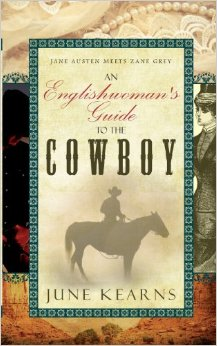
The other book that I am ‘currently reading,’ is An Englishwoman’s Guide to the Cowboy by June Kearns.  I was led to this book because of its reviews on Twitter.  Kearns is a UK writer and they called this one a humorous western.  What an interesting mix! I purchased it and downloaded it on my Kindle.

In this read, Annie is traveling the American West in a stagecoach with her aunt and cousin.  She is about to be wedded to an older gentleman in New York who she finds uninteresting and a bit repulsive.  They have traveled to San Francisco and are now somewhere in the area of Arizona and Texas when there is a mishap.  Annie wakes up with a man standing over her nursing her head, after she’s had a concussion. Her aunt and cousin are nowhere to be found. She has no choice but to trust him because she is truly ‘damsel in distress.’

Annie has to leave all of her belongings behind as she goes on an adventure with this total stranger.  She sees a paper coming from his satchel and notes that he is a horse thief and wanted for murder.  But there are Comanche Indians all around so her options are few. How will this English lady fare in the dangerous American West with this cowboy?  Will he help her or harm her?

Lynn                                                                                      October 29, 2014

The Harvest

Leaves of grass; oh, how they blow,

Colorfully spread for someone to mow.

2014! Astoundingly rich in hue,

Orange, yellow, red and even blue.

Autumn or fall whichever you may call it,

A time of harvest and to reflectively sit.

Gathering those fruits of labor from all around,

Moving to the year’s end with a mind, sound.

All pieces of work stacked in a neat stock pile,

Reviewed, proud; giving smiles lasting a mile.

harvest

Lynn                                                       October 27, 2014

Colorful Leaves: Great Significance

Golden Leaf

I have always been fascinated with leaves.  It probably started with a 10th grade project when I collected a notebook of leaves and attempted to identify them for a science class.  My teacher seemed to appreciate my efforts.   In college, I studied Walt Whitman’s Leaves of Grass.  I still remember certain poems from that collection, but the title itself speaks volumes.  Many are still drawn to that work today.

After doing some quick research, I learned that the autumn leaves are colorful because during this season they stop producing their food or chlorophyll, which gives them the green color. As a result, the colors behind the green are revealed or unmasked and we see the oranges, yellows, reds and a host of other pigments and tints.

This particular autumn has been notably spectacular and many people have been tweeting out beautiful pictures of colorful trees in all of their glory.  People who are not photographers have been moved to snap these pictures because we all know that things can change ‘in the twinkling of an eye.’

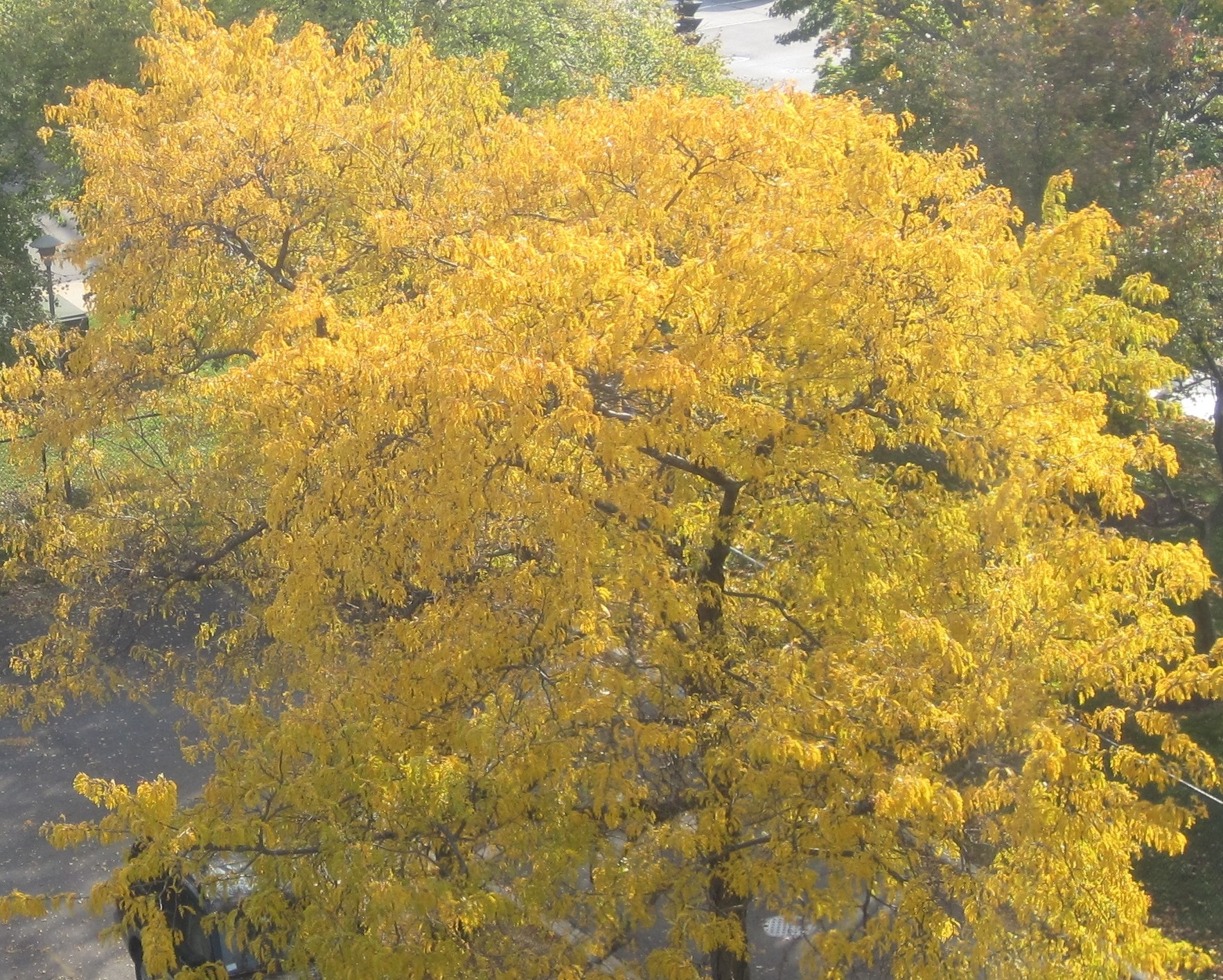
The other day, I tweeted a picture of a yellow tree that I took from my window.  Today, it looks totally different.  Many of the leaves are gone.  The research also told me that the brown leaves are filled with waste or as we might say, they are on their last legs.  They then become brittle and will soon be in a heap or pile.

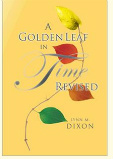
This makes me think of the cover design of my novella called A Golden Leaf in Time Revised. I had my own visual in mind and gave it to the design team of the publisher.  They stayed close to my idea but chose to take the leaves in an upward position.  I originally had them going across.  However, I was very pleased with the finished product.

Golden Leaf thumbnail

The color of the leaves is quite significant because they represent the stages that Phoenix goes through in order to reach a higher state of existence.  She starts off as the green leaf on the bottom of the branch.  In fact, she is in what we call a pickle or a set of difficult circumstances.

Yet, she continually sheds wastes, baggage and worn-out conditions as she transforms.  Her stages of growth are shown by the different colors of the leaves on the cover. She vows to ‘turn over a new leaf’ throughout the book and ultimately becomes that ‘golden leaf.’  She has become the best person that she can be at that point in her life.

Yes, colorful leaves can be very captivating and their richness in hue has caught the attention of many spectators this autumn season. For writers, leaves can signify a number of things like the pages of a book but in my case they represent the metamorphosis of my main character, Phoenix.

Lynn                                                                                                October 25, 2014

Swan Lake: Descriptors!

ballet shoes

According to Merriam-Webster Online, a descriptor is  something (as a word or characteristic feature) that serves to describe especially: a word or phrase (as an index term) used to identify an item a subject document) in an information system.

After recently seeing Swan Lake presented by the Joffrey Ballet Company, I chose to use mere descriptors to share my experience.  Rather than retelling the story of good versus evil, here is a list of words describing what I felt as I observed this fantastic performance.

Reactions to the Dance Form

elegant

flawless

exquisite

cooperating costumes

twirling skirts

breathless

toe shoes

precision

silent awe

timed choreography

grace

lifts

jumps

high leaps

quality cloths

silks

satins

sequins

colors

perfection

inaudible storytelling

designers

stage props

pointed toes

tiaras

swans

gentlemen

When I think of the orchestra who accompanied the ballet company, I think of Denise Levertov’s poem, Tree Telling of Orpheus.  Here are a few lines:

“But the music!

The music reached us.”

… and the way we danced.

The music!”

The music descriptors

conductor

orchestra

mastery

perseverance

specialized solos

bassoon

flute

oboe

piccolo

strings

violin

bass

cymbals

tympani or kettle drums

bells

clarinet

French horn

trills

It was a day to remember!  Swan Lake was beautifully done!

Lynn                                                                                                                                          October 23, 2014

Why Do We Write?

Cherry Monte Blanc

Why do writers write?  For me, it is a rather compulsory action and I feel there is little choice in the matter.  Writers and most real artists are highly sensitive people.  Our antennas probably extend a tad further upward and outward into the atmosphere.

What some people may ‘blow off’ or ignore affects the writer more deeply.  Others may walk by and barely give a sigh, but with a writer, an event or incident remains and stays a little longer.  Earlier today, I was driving along and noticed that a man in a pick-up truck had pulled over to the right.  It was raining lightly and I could see that there was a ladder and several long 6- foot metal poles in the middle of the street.

He was apparently in distress and I immediately pulled over behind him.  It was not much that I could do, but I put on my flashers to alert the other drivers to at least slow down.  He had lost his work equipment and was trying to retrieve it.  What most amazed me was the insensitivity of the other drivers.  They seemed to speed up and not one other person stopped.    It was not a huge street, but it was certainly busy enough for there to be a catastrophe if conditions had deemed it so.

I just sat there as a silent support as he made at least five trips with full arms to get all of his equipment. He placed the items back on the open flatbed of the pick-up truck.  After he had finished, I pulled off and headed on home.  This was a prime example of what I meant by people blowing things off.

I empathized with this man and that is what we as writers do well.  We write because we feel.  We feel others’ pain and we most certainly feel our own.  We write to heal, to feel better and to reach another state of mind.  We can talk it through on paper until we see situations from another angle and we are then able to advance.

Writing helps us navigate life’s meandering road.  If something is unsettling, we write to get our bearings.  We write to reach our own truth, our own reality and for me this helps me validate my feelings.  I can take ownership for what I am feeling and cleave to my right to have those feelings until I can turn the corner and find some new perspectives.

We also write to probe or discover what is hidden inside.  We all have stored information and writers are often surprised at what emerges from those suppressed files during the writing process.  Sometimes there are snippets of stories and tales somewhere down at the bottom and as we write, some of what we have heard or seen may come pouring out on the page.

I was reminded of one of the Greek myths and had to revisit the story of Midas and the whispering reeds.  Apollo gave Midas the ears of an ass (donkey) because he was angry with him.   Midas wore a turban to conceal his shame but his servant had to cut his hair and saw the ears.  He could not keep it inside but he knew that he could not tell anyone.  Instead, the servant went towards the waters, dug a hole and whispered the secret in the hole and covered it up.  The reeds grew and the wind blew as the reeds waved and told the tale, “Midas has the ears of an ass” (donkey).  Soon, the whole world knew his secret.

What was hidden inside may come to light in our writings as we heal ourselves and entertain others.  All writers hope that they can make that connection and some reader will say, “I can relate to this.  I understand.  I have seen this. I have felt this way.” We all want to touch others with our words. But one thing is certain, we write because we must.

Lynn                                                                                                  October 15, 2014

Perfect Peace & Claire of the Sea Light: Characters, Plot and Setting

Perfect peace

I chose two books when I visited Barnes and Noble last month.  I was pulled towards them as they seemed to say, “Try me.”  I left with Edwidge Danticat’s Claire of the Sea Light, and Perfect Peace by Daniel Black. I had read Danticat’s other books, Breath, Eyes, Memory and The Dew Breaker.  I saved her book for last because I thought it would be serious in nature.

Starting with Perfect Peace, I found that the element of characterization was most pronounced.  The mother, Emma Jean, was an unloved child and a victim of verbal and physical abuse at the hands of her mother. She desperately wanted a little girl to adorn and shower with the love she had never received.  She took her seventh son and decided to dress him as a little girl.

She was able to fool the entire family and they thought that Perfect was a girl until she turned eight years old. When Perfect started asking questions about becoming a woman, Emma Jean took her to the woods, told her that she was a boy, cut off her hair and gave her some overalls.  She showed her what a woman really looked like and told the family what she had done.

Gus, the father, was outraged, beat Emma Jean and changed Perfect’s name to Paul.  This book was strongest in characterization because every member of the Peace household was affected by this horror.   Gus and the six boys, Authorly, Woody, Mister, Bartimaeus, Solomon and James Earl were forever changed by this family anomaly.  They then had to try to teach Paul how to be a boy.

Of course, Paul and his reactions were central to the story and Emma Jean later faced the consequences of her actions.  I felt as if I was sitting in the Peace home watching the events unfold.  It was set in rural Arkansas and the setting was important because I am not sure if this shrouded secret would have remained in a metropolis or large city.

The other book, Claire of the Sea Light, by Edwidge Danticat, had a surprisingly lighter tone than her other two works that I had read; however, this book was quite entertaining.  The strongest elements here were both plot and setting.  This story took place on the small island of Haiti and the author showed how the people’s lives were interwoven and connected by an invisible thread.

I thought of two interlocking hands because as the islanders looked for Claire, so many of their own stories were told through subplots.  Claire’s widower father, Nozias, was about to give her away to an affluent woman who had lost her only child.  Claire disappeared after her seventh birthday party and as the reader waits to see if she returns safely, there were tales of a tragic drowning, a couple of murders, a cover-up, clandestine affairs and an attempted suicide.

The plot was the strongest element but the setting on an island helped to show the relationships amongst the people. One life truly touched another in this limited geographical space.  The reader was held in suspense while waiting to see if Claire returns in one piece to face whatever life holds for her.

Claire of the Sea light

Lynn                                                                                                                        October 13, 2014

New Paul Laurence Dunbar Statue!

Dunbar statue

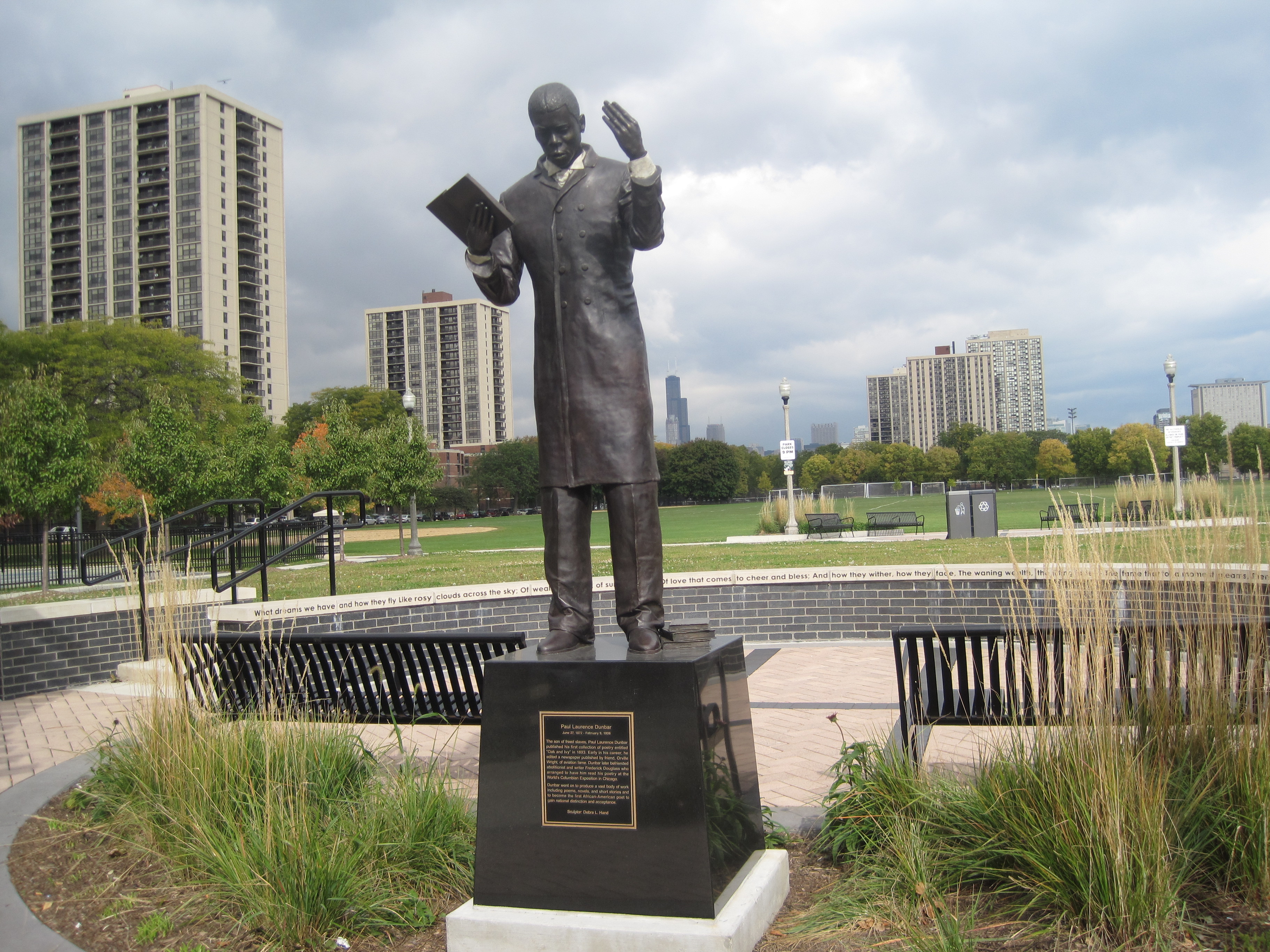
I was driving on 31st Street the other day and looked to the right to see the new sculpture of Paul Laurence Dunbar in Dunbar Park.  I knew that there had been a recent dedication of the statue and there it was, awaiting my attention.  I vowed to come back and take pictures and share this new gem on my blog.

It sits behind the high school of the same name where the famed singer, Jennifer Hudson attended.  When I think of this great poet, I think of the poem, We Wear the Mask. I quote it often because it speaks to me when I feel that people are not being honest with me. I also knew that he wrote in dialect and lived a short life.

So, after a little fact checking, I discovered that he was born to freed slaves from Kentucky and he was born in Dayton, Ohio in 1872.  I also learned that he was the only African-American at his high school where he became the President of the Literacy Society.  His first poems were published at the age of 16, and he also wrote lyrics.  He became nationally known and was recognized by author William Dean Howell (Wikipedia).

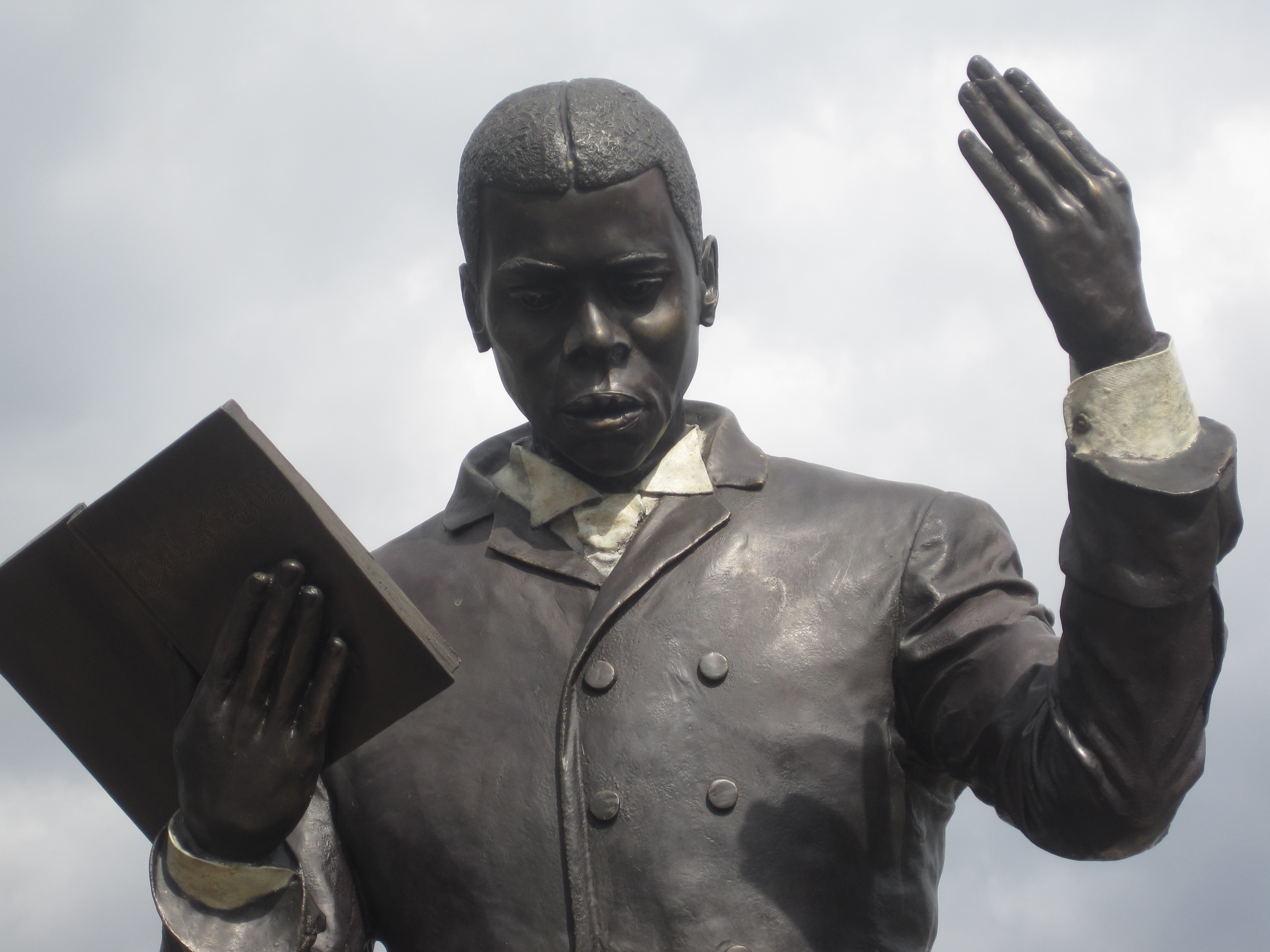
On the next day, I drove over to the actual statue.  It stands about six feet tall and was sculpted by Deborah Hand with the assistance of her son, Brian.  “In March 2012, Deborah Hand, who was assisted by her son, Brian, was selected to create and complete the statue. According to Mr. Hand, they were selected after submitting an application as part of an open call for artists.

Mr. Hand estimates that the statue of Dunbar weighs between two to three tons, cost an estimated $80,000 in materials to create, stands a total of nine feet tall when mounted on a granite slab, and was completed in about 20 months.” (Edwards, Lee. Paul Laurence Dunbar Statue Unveiled at Dunbar Park, Weekly Citizen-Sept 10, 2014)

The inscription on the statue tells us that Paul Laurence Dunbar met Frederick Douglass during his lifetime and was invited to read poetry at the World’s Columbian Exposition of 1893.  I did not know that he had read at the Expo.  After teaching eighth graders about the meaning of the four red stars on the Chicago flag, this piqued my interest. The third star symbolizes the World Columbian Expo of 1893 and the actual Expo took place a short distance away from where the statue stands.

The inscription also says that he edited a newspaper owned by the aviator Orville Wright.  Though Dunbar died of tuberculosis at the young age of 31 in 1906, his life touched the lives of greats such as Orville Wright, Frederick Douglass and William Dean Howells.  We still honor and quote his works today and I am happy to witness this magnificent addition to the city’s landscape.

Paul L Dunbar close-up

Lynn                                                                                                                          October 11, 2014

Alternate Choices

Divvy Bikes

The other day while I was on the lakefront, a couple stopped me and asked how far they would have to walk to get to the Museum of Science and Industry.  They were obviously tourists and I told them about 25 blocks.  I assured them that it was something that they could do and certainly with each other’s company, which they seemed to enjoy.

I let them know that getting a bus there would be rather difficult after they inquired about other choices of transportation. It could be done but not without a lengthy walk and a bus transfer.  They thanked me and proceeded on the bike trail that sunny and mild October afternoon.  I assumed that they had chosen to walk as I went on to my car.

Yet, as I was driving away from the lakefront, I looked over and saw that they had decided to rent two Divvy bikes instead.  I was amazed as I saw them leaving the bike station and about to mount their bikes.  I could not get their attention, but if I had, I would have thrown them a “thumbs up,” to let them know that they had made an excellent choice.

“In 2007, Chicago Mayor Richard M. Daley visited Paris, France, where he personally tested out their Vélib’ bicycle sharing system and was “greatly impressed.” He determined that a similar system would work well in Chicago” (Wikipedia).   http://en.wikipedia.org/wiki/Divvy

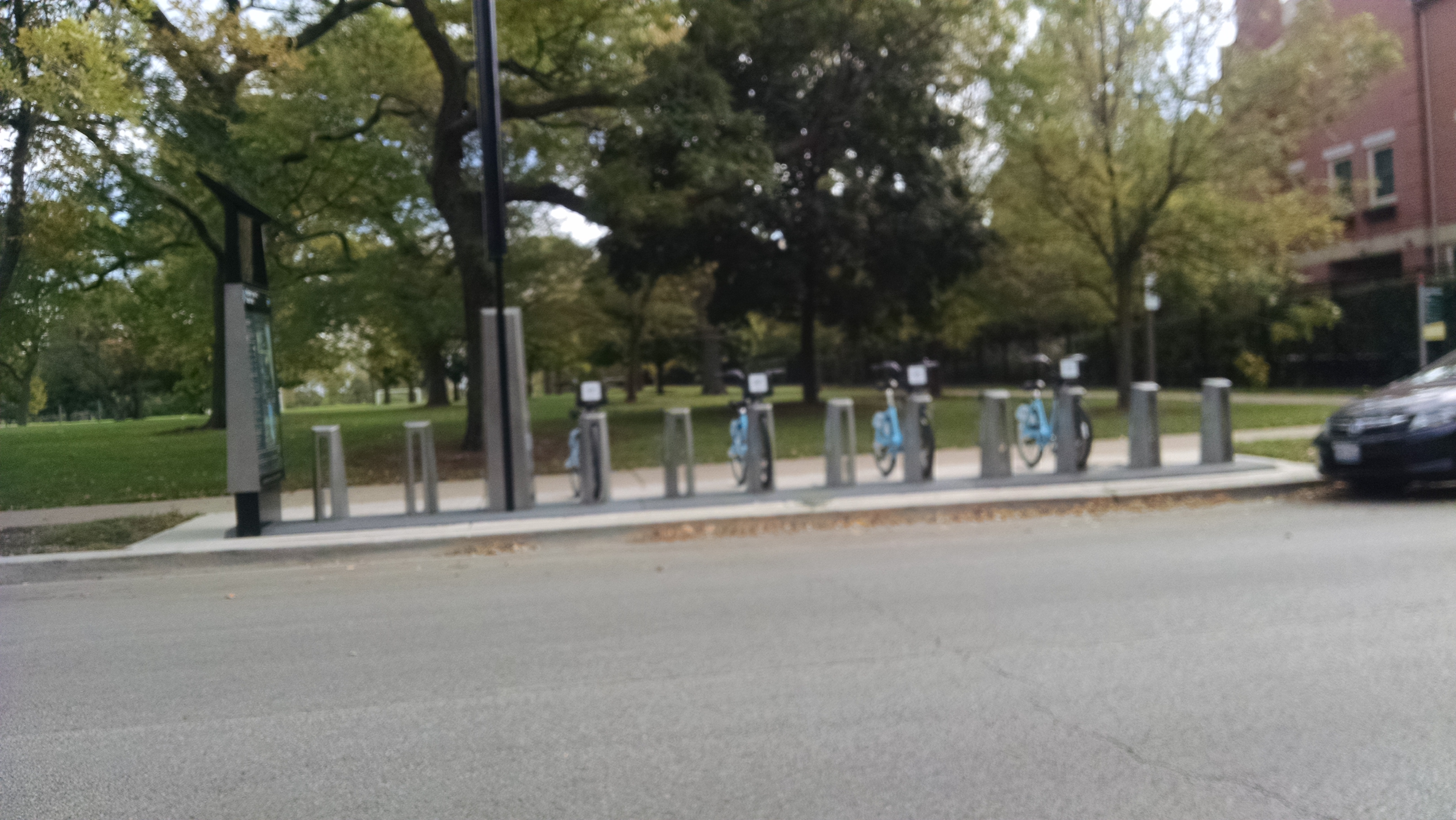
It reminded me that we can ask for suggestions and information.  We take what was given and combine it with our own mindset and come up with a solution or decision that we can live with. Together, they surely enjoyed the scenic Lake Michigan at a comfortable pace. Later, I stopped to take pictures of one of the many Divvy bike stations around the city.  I read the sign and saw that it  only costs $7 for 24 hours.  It would cost that much for a couple to simply enter a cab.

“Divvy is a bicycle sharing system that launched in Chicago on June 28, 2013 initially with 750 bikes at 75 stations spanning from the Loop north to Berwyn Ave, west to Kedzie Ave, and south to 59th St. The system was planned to grow to 4,000 bicycles at 400 stations by Spring 2014 (Wikipedia). http://en.wikipedia.org/wiki/Divvy   Current mayor, Rahm Emanuel fully supports the Divvy bike program and it gains further popularity daily.

As with this young couple, there is nothing like having choices in life or alternatives.  With the biking choice, they could move with speed, have the opportunity to flex those rarely used muscles, and blow out the mental cobwebs as they cruised southward along the calm Lake Michigan.

We did briefly discuss other choices of transportation they could use after enjoying the museum.  They could return to their hotel by cab, bus, train, bike or walk back.   They had multiple choices from which to choose. We make choices that make us happy or sad; but choose, we must.  They seemed elated with the inexpensive, healthy choice that they had made as they led their blue Divvy bikes across the overpass towards the bike trail.

Lynn                                                                                                              October 9, 2014