Our Precious Commodities: A Tribute to Whitney

download

Sometimes when there has been a great loss, we jog because the pain might catch up with us. And the pain can be so excruciating.  But after we finish running, we turn and face the lion on the pathway. And so this brings my turning and facing the loss of Whitney.

It has been over two and half years and I now face the lion on the path.  I was watching The Preacher’s Wife last week though it is not yet Christmas. I simply enjoyed watching the movie and mostly getting a chance to see Whitney again, in all of her glory.

Then, the movie came on again the other night on Oxygen and I sat down and really watched it more closely.  Just as in the movie, the theme centers around taking our precious commodities for granted.  A husband and wife have fallen into a slump and it takes the appearance of Dudley, the angel, to help reawaken their love for each other.

How timely!  So many times, we take our stars, singers and beautiful gifted ones for granted expecting them to always be there.  However, we are only blessed with their earthly presence for a season.

But, this post is all about Whitney, our precious angel.  It is interesting how the gods seem to make the stars beautiful both physically and in talent.  She was a beautiful woman who could wear an evening gown like no other.  As one phrase goes, she was ‘pleasing to the eye,’ and was showcased to His glory before millions.  Whitney put the “E” in elegant.

As I continually thought about Whitney, I remember the soundtrack from The Preacher’s Wife.  My mother had that CD at the time and played it regularly.  It was one of her mantras.  I especially remember, the cut, “I Love the Lord; He Heard My Cry.”  Fortunately, I could go to the Internet and listen to it again.  I was reminded of a recent conversation with a musician friend who was grieving over the loss of keyboardist, Joe Sample.  We both agreed that we are so lucky to have U –Tube and other electronic recordings to relive those notable moments that these artists have left behind.

Also, I went to Best Buy in hopes of getting the soundtrack from The Preacher’s Wife.  They did not have it. But, instead, I left with her first CD called Whitney from 1987.  I left feeling a little disappointed but when I got home, I  discovered that it was her first album and realized that I had gotten a piece of gold for an inexpensive price.

Her spirit touched mine as I sat in the car at the lakefront and listened to this CD from the beginning of her career.  The songs that truly touched me are: Didn’t We Almost Had it All; For the Love of You and Where do Broken Hearts Go?  She closes with a duet with her mother Cissy Houston, I Know Him So Well. One cut that did not make it big from the album is Where You Are.   I liked it though I cannot say I heard it on the airwaves during her debut days.

It was a great revisit with the younger Whitney and it made me think of my journey during her lifetime.  Musicians do set the soundtrack for our lives and we can remember exactly where we were and what our mindsets were during the time that those songs were popular.

There are so many memories of Whitney.  The songs, the movies and oh just so much!  When she was Brandy’s fairy godmother in Cinderella, it was quite apparent that she had a heart of gold and I miss her.  I really miss her. In 2012, when she left us, there was such a lump in my throat.  All I could do to cope is, as I opened by saying, simply keep jogging in my mind.  Try to accept it and keep on moving.

If we take an honest look at what Whitney left us, how could we ask more of her?  We are only on loan to each other.  The comforting thing is that people who have gone on never really leave us.  They are, as my sister Janet, said about our mother, “somewhere close.”

One night, I was having a difficult time and I heard Whitney singing, I Look to You,” all night. It was as if she was serenading me and I felt comforted as her soulful voice rendered solace and peace.  Now, our precious commodity, Whitney is an angel looking out over us and with a protective wave of her magic wand, she is still bringing joy and comfort to those of us who love her.  All we have to do is turn on the music and feel her still standing close by in a long, exquisite evening gown.

Lynn                                                                                                         September 17, 2014

Our Boys Play!

Jackie Robinson West

The other day, as I was driving through the heart of the city, I noticed a group of young adolescent boys playing football.  It was a refreshing sight!  I was tempted to pull over and just watch for a while, but there was no immediate place to park.  But my heart lingered behind as our boys were suited up in football gear and helmets as they took the field.

As an educator who is crucially aware of the inner city plagues, it warmed my heart to see these positive images in spite of the daily fears for our youth.  My thoughts also ventured to the parents who silently drive their children to these events and strive to pay whatever fees.   They truly work hard to give their children an opportunity to have some viable outlets and avenues in life.

I thought briefly of one of my nephews who played little league as a child.   As an adult, he currently works in the field of sports and has done so for years.  Those childhood experiences helped to shape him and positively affected his career choices.  And that leads me to our latest victory this summer.  We are still reveling in the success and joy that our little leaguers, the Jackie Robinson West, brought to the city.  The boys were gracoius and did not disappoint us as an all-American American team of 13 boys, aged eleven to thirteen.

Rarely do we get a chance to showcase our youth in such a wonderful light, but we educators know that there are many great children existing and thriving.  This team, led by Coach Darold Butler, made us proud as a city.  The children were not only good on the field, but they had been trained and were well-versed as they handled the media and public.  It brought warm, fuzzy feelings to many of us.

They became the National Champions and the City of Chicago pulled out all of the stops in acknowledging their achievements.  They had a victory ride on tourist buses through the city and ended up in the renowned Millennium Park. There were over 10,000 people present to cheer them on.  Later, there was a fireworks show in their honor, thanks to the City’s mayor. Also, the field where they currently practice is due for a $6.5 million upgrade in the near future.

The White Sox allowed them to sport their 2005 World Series trophy for a while.  They were also allowed to ‘stand with the players and the sing the National Anthem before the White Sox took on the Detroit Tigers’ at U.S. Cellular Field (Madhani, Aamer. ‘Little Leaguers still knocking it out of the park.’ USA Today- September 4, 2014).

The Cubs gave them time on their Wrigley Field and gifted them with ‘specially made Jackie Robinson warm-up jerseys’ (Madhani).  There have been  monetary gifts and they recently returned from a weekend at Disney World. These experiences will stay with these young men for the rest of their lives and they have brought so many smiles and happy tears to our city and certainly to the African American community.

When the southerner uses the phrase, ‘that is high cotton,’ it means that someone is playing with the big leagues or in the company of those with great influence.  Well, our boys had this wondrous experience and it brought pride to our city and further united us.

This pre-teen age group can be one of the most challenging because we often do not know how to reach them when they are angry and full of angst.  So back to the old child development rules, play not only works, it adds balance to a child’s life.  According to psychologists, play helps them with social competence and emotional security.

Jona K. Anderson-McNamee of Montana State University writes,” Play helps your child learn the rules of your family and what is expected of him or her. As children grow, play helps them learn how to act in society.” After this historic victory, it was recently reported that many new little boys are signing up for the new Jackie Robinson West camp and are getting ready to listen to the announcer when he says, “Play ball!”

Lynn                                                                                                                September 15, 2014

Imagery and Scenes

Some writers spend extended amounts of time on settings and scenic descriptions.  That is a true luxury for those with plenty of time to write, create and truly color the images and scenes.  We working writers have the will to write but must do so after a 9 to 5 or in between breaks.

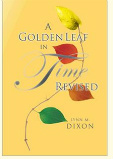
Therefore, the descriptions of images and scenes are somewhat limited. However, I would like to share three scenes filled with imagery and see if they meet the goal of developing a pictorial image in the mind of the reader.  First, we see Phoenix’s aunt’s beloved rose bushes from A Golden Leaf in Time Revised.

sweetheart roses

“Later, after having breakfast, they sat out in the greenhouse and continued to relax and talk. Her aunt shared the beauty of patience as she nurtured her beloved flowers as they grew. She had an abundance of crape myrtles, which she explained came from the Natchez area. She talked about her dogwood flowers, which had to be cut back to avoid them from growing into trees. She pointed to her honeysuckle plants and told Phoenix that they grow easily. She said that she often cut off some pieces and put them in water to give the house a pleasant aroma. And lastly, she talked about her special rose bushes. She was especially proud of her sweetheart roses, which she spent time cutting back as they relaxed in the backyard.”

Phoenix is able to forget her current concerns as she listens to her aunt’s melodious voice describe her garden.  It shows how the aesthetics of nature can calm the soul.

In another scene, Phoenix drives from the impoverished neighborhood where she works to a more affluent community where she resides. She makes this drive daily and the reader gets a sense of the change in scenery as she heads home, closer to the center of town.

“As she drove from the library, she could see the broken glass, broken windows, and boarded-up businesses, all representatives of broken dreams. As she got closer and closer to the university area, the streets widened, the houses became neater and more prosperous, and the shrubbery became more beautiful. Such is life, she thought. The haves and the have-nots. Low self-esteems and high self-esteems. The dichotomy of life. But, she thought, you can only help those who will receive it.”

Some writers write detailed descriptions of landscapes almost to a fault.  If I had the time to write a long work of fiction with 300 to 500 pages, I would still limit my time spent on scenes and imagery.  I would not want to put the reader to sleep. I want to activate their imaginations because to me, reading is personal.  Readers have their own painted images in mind of how things look as they read a literary work.

Sometimes, when books become movies, some of the imagination is distorted because the reader may have imaged a scene or person one way and the script and actors give it another.  Yet, that is a discussion for another time.

In one last scene, we see Trey running on a jogging path at the pace of a mad man after a heated argument with his girlfriend, Flora.

“He threw on his jogging suit and running shoes and took an extra jacket. Though the weather was brisk, he took the elevator down, walked over to the lakefront, and broke into a breakneck speed as though something or someone was chasing him. He ran and ran until other more regular-paced joggers looked at him as he passed. They could detect that he had the momentum of a person with a problem. He did indeed!’….

 He found a patch of grass and sat down as he panted. Tears rolled down, and they seemed endless. They would not stop. He had his back to the streets because he did not want anyone to witness a grown manin crying mode. He was glad that he had a neck towel around his neck,which also served as a handkerchief. He let it all hang out and threw in all reasons for crying, such as missing his mother, having to marry Flora, and the possibility of losing his job. He waited for the pain to subside, and when he felt stronger, he walked over to a rock. He sat and looked out over the horizon feeling shipwrecked.”

So, even though we working writers must, “tell thy story quickly,” as Macbeth said, we still strive to create enough images, imagery and scenes to pique our readers’ interest.  The bottom line is,   “Can you see it in your mind’s eye?”  In this age of high-tech, fast-moving environs, sometimes ‘less is more!’

Golden Leaf thumbnail

Lynn                                                                                                                   September 13, 2014

Mothers and Daughters- That Special Bond

Mother-daughter

How many women have looked in the mirror and exclaimed, “Wow!  I have become my mother!”  I have seen my handwriting look more and more like my mother’s, along with some of my gestures and facial expressions that remind me that I am my mother’s daughter.

Mothers and daughters have a special bond and through its myriad stages, the tie is always bound by a deep and abiding love.  Two books come to mind that have helped me along the way on this subject which are Nancy Friday’s My Mother, My Self and Alice Walker’s In Search of Our Mother’s Garden.  Both books gave me alternate ways of viewing mother-daughter relationships.

These loved-filled relationships can also have periods of contention during power struggles. Adult daughters of aging mothers know that their roles gradually reverse and the daughter may become the parent.  But the aging mothers will not ‘go quietly into the night,” and wars can ensue.  However, in both of my novellas, the mother is still administering the comfort and solace to her daughter.

In A Golden Leaf in Time Revised, Septima comforts Phoenix after she takes a day off from work and is resting at her mother’s sister’s home.  After the aunt has said and done all that she can, Phoenix calls her mother long distance.  Her mother advises her.

“Her mother’s closing words were, ‘Remember, Phoenix, that no person, no thing, no set of circumstances can by any possibility interpose itself between you and your good. They are there for your own spiritual growth. I know you can’t see it now, but you will. They’re like growing pains. Your higher good is on the way. Something good will come behind this. Try to relax, and try not thinking about it for today anyway. Enjoy your stay there and your day off.’

Nancy Friday writes from My Mother, My Self, “The primary rule is always that a mother can’t go wrong, ever, by encouraging her child after age one and a half to be as individuated and separated as possible. If she was not as good a mother before as she would like to have been, she must get over her guilty desires to overcompensate, and place herself on the side of the child’s developing.” 

In the sequel, Warm Intrigues, Septima and Phoenix are now living in the same city.  They are close and the mother notices the positive changes in her daughter once Phoenix is dating a new guy.

“Her mother walked around the one-bedroom place and showed an approving bow of the head. “Nice. Really nice. Nice view and lots of sun which matches your disposition,” she said.

“Well, thanks, Ma. That is a compliment. A real compliment,” she added.

“I thought that the sun had left, but it has come out again,” she said.

“Meaning?” asked Phoenix.

“There was a long stretch of gloom and curt responses, but it seems that the little girl that we raised is coming back into her own,” answered Septima. “And I might add that this young man, Tyre, has helped in restoring some of the light.”

“Aw, Ma.” Phoenix blushed”.

Alice Walker writes, “My mother had handed down respect for the possibilities…and the will to grasp them.”  Of course, Septima wants the absolute best for her daughter and is quite happy to see her being restored to her natural state of beauty.

Phoenix looks at her mother in another scene and privately hopes that she will be like her mother when she is older.  She comments on her mother’s fashion choices.

“You are looking mighty spiffy, Ma,” exclaimed Phoenix. “You got a hot date?”

She looked her mother up and down and saw her skinny legs jeans,

small low-heeled boots, and a nice camel-colored cashmere wrap.

“I might,” her mother laughed.”

From Alice Walker’s In Search of My Mother’s Garden, she defines a womanist as, “Loves music. Loves dance. Loves the moon. Loves the Spirit. Loves love and food and roundness. Loves struggle. Loves the Folk. Loves herself. Regardless.”

The bond between mothers and daughters is eternal.  Even if our mothers are no longer physically present, we still feel them hovering and protecting us.  All of those wonderful images of her during her earthly existence are forever etched in our memories and psyche.

Lynn                                                                                                              September 11, 2014

Safeguarding Our Precious Enterprises


e-book

I am reading a British Twitter writer’s book called Fraud written by Peter Davey.  The author’s website called Goodreads often asks us what we are ‘currently reading.’ I am not that far into the book but it centers on the compromise of a writer’s manuscript.  In this age of advanced technology, we hear stories, almost every day, about valued documents or financial accounts being stolen, hacked or attacked by outsiders.  Feelings of intrusion and vulnerability are prevalent in an era when precious documents can be defrauded and our assets or identities are at stake.

I was reminded of a story that I had heard earlier about a famous author losing his writings.  At first I thought it was Flaubert, but after further research, I found the story I had in mind. During the summer of 2011, I did an author study of Hemingway.  I often study one author at a time and focus on all or some of those works along with a biography.  I started that enterprise after reading The Paris Wife by Paula McLain, which was a hot item at that time.  It focused on Ernest Hemingway and his first wife, Hadley and their times in Paris.

That led me to further study him and his works at an adult age where I could fully appreciate his messages.  I drove to Oak Park, where he was born, visited the Hemingway Museum and went on a tour of his boyhood home which is right down the street from the museum.  I went on to read: The Sun Also Rises; A Farewell to Arms and For Whom the Bell Tolls.  I also read his last wife, Mary Hemingway’s account of their lives together in How it Was.

All of this leads back to the main point.  I found the story that I was looking for about a lost manuscript.  His first wife, Hadley put down a piece of luggage at the train station Gare de Lyon in Paris. She was going to meet him in Switzerland.  She went to get a bottle of water (Evian) and when she returned, the luggage was gone. It had all of his manuscripts in it along with their carbon copies.  What a horror? He later wrote Ezra Pound about the incident and he said, “Good, etc. But don’t say it to me.  I ain’t yet reached that mood.”

Well, today, many writers’ works are being digitized and scanned to make sure that these types of things occur less often.  Even though this lost work of Hemingway’s was not published, libraries are now taking extra precautions to make sure that published works are safeguarded.

E-books and in my case self-published books help get rid of those little pockets of handwritten manuscripts and notes that may be seen as junk and thrown away.  In the article about Hemingway’s lost works, someone mused and wondered whether his writings were thrown away when they did not see jewels or what they perceived as valuables.  Or, they continued to wonder if the writing would turn up in some attic years later once someone saw that it is the writing of a Nobel Prize winning author.

But, as I was searching for this story, I came across a recent undertaking that did involve Flaubert’s works.  Now, the University and the Municipal Library of the city of Rouen in France have scanned the entire manuscript of Madame Bovary.  “One hundred thirty volunteers from a dozen countries, of all ages and professions were recruited for the transcription which took two and a half years, between 2003-2005.  Each page represents the equivalent of half a day to a full day of study, Flaubert’s handwriting being difficult to read and sown with barred text.” (Madame Bovary original manuscripts available online).  They have even scanned his handwritten notes written in the margin and because they now see the pricelessness of his personal annotations.

Thank goodness for digital literacy and the new way to safeguard our works.  That was one of my reasons for self-publishing.  My first reason centered on the fact that I hoped that my writing could help or guide others.  The second reason was a way to bind those snippets of paper lying around. This is how my book Traveling Streams came into existence.  Now, writers have a better chance of protecting their manuscripts through the digitized media and saving it in multiple places, knowing that we can access it from different points.

Lynn                                                                                                                September 9, 2014

Memory Devices for Our Children

I have worked with youth of varied ages and I am often amazed at how many old, fundamental learning techniques are no longer in use. As the saying goes, “If it isn’t broke, don’t fix it.”  Some of the old methods such as recitation and repetition worked quite well.  We used to call them drills and though they could be heard by passersby, they worked.  Students remembered and it showed on tests and other assessments as students retained information.

According to ehow, it states,” A useful technique for enhancing memory is to recite and repeat. When a person recites an idea or new information aloud, the concept anchors in two different senses. A person will not only hear the information but also feel a physical sensation in the throat and on the lips and tongue when reciting the concept.” 

 I do not believe that there is enough recitation in schools these days.  I worked with a principal a few years back and he employed the most interesting way to utilize student wait time.  As students were waiting in line to pass from the lunchroom, he had the entire class recite a chosen number of their time tables in unison.  For example, he might tell them that they had to recite their 11’s and they did.  It was nice to hear it.

Time tables

It reminded me of how I learned my time tables and if put to task, I could still do it.  I have since found that many of the upper middle school children do not know their time tables.  If asked a math question, I have seen counting fingers come out or a search for a calculator.  Both were bothersome images for me.

Recitation does work and that information will come back to the surface. I can still remember parts of Hamlet’s soliloquy, “To be or not to be,” that I had to recite for a Shakespeare class in college. Reciting truly helps store information away in our memory banks which can be retrieved when needed. Drills need to be reincorporated on all grade levels and I believe that there would be an upsurge in school test scores.  We are never too old to recite, sing or practice through oral language.  The participation requires an action which activates the mind and makes information stay with us longer.

When I was in elementary school, we used to sing on a regular basis. We sang in the afternoons and it was a form of relaxation from the earlier drills of the day.  I still have fond memories when I hear the song, ‘O Shenandoah.’  I test myself to see how many of the words I still remember. Singing taught us teamwork as we sang in unison and recalled the lyrics.

I did a baseball unit and taught the 3rd and 4th graders the song, “Take me out to the ballgame.”  The students were uncomfortable at first because they were not accustomed to singing in unison with their classmates.    I put the words on a large post-it and they actually enjoyed it. From that point on, they will be able to sing along with the televised ball games when they hear the song. The interim principal said that it warmed his heart to hear the children singing as he walked by the library.  We all know how the singing voices of little ones make us feel.  They remind us that life goes on to a beat and a rhythm.

In another instance, I realized that many of the children did not know the nursery rhymes that I was referring to in a lesson.  What is a child’s life like without Mother Goose? I immediately got busy and found a website called byGosh.com.  I projected it and we started reciting and learning some of the old basic rhymes like Jack and Jill. Various websites claim that these nursery rhymes teach phonological awareness and word families.  To me, they teach poetry, recitation and peeks into eras of time.

When Jack broke his crown that should automatically generate a discussion about why Jack had a crown and what that meant in comparison to today. Or when Humpty Dumpty had a great fall, and all of the king’s horses and men could not put Humpty Dumpty together again, this is a great time to talk to the children about the king and his men. And of course, we cannot leave out the fact that Humpty Dumpty was an egg.

As I did some research for this post, I discovered a mnemonic device for remembering the Great Lakes.  It was new for me and I really liked this one because the Great Lakes have always been a part of my life.  So, HOMES helps students recite the five Great Lakes: Huron, Ontario, Michigan, Erie and Superior.  Now, I won’t forget this memory device.

There are so many ways to help our students remember what they need to know. Recitation, repetition and drills can still help our children retain information.  It may be a little noisy for the other family members as our children repeat things that they are learning, but these techniques have been tried and tested.  They are foolproof and the needed skills will be in their heads waiting to be retrieved, when technology is not available.

Whether remembering those pesky time tables, the lyrics to some song or a nursery rhyme, all of that recitation, drilling and repetition truly pay off.  Like money in the bank, the information is there for a withdrawal upon request.

Lynn                                                                                                                  September 7, 2014

Coming Clean!

Warm Intrigues -Cover

“I grew convinced that truth, sincerity and integrity in dealings between man and man were of the utmost importance.”  from The Autobiography of Benjamin Franklin

This quote from Benjamin Franklin reminds me of the themes of both of my novellas, A Golden Leaf in Time Revised and Warm Intrigues.  In the first book, A Golden Leaf in Time Revised, both main characters, Trey and Phoenix, are involved in tumultuous relationships that are adversely affecting their careers.  They are  finally able to extricate themselves from those relationships before they ultimately find each other.

Once they do meet, they realize that they must ‘come clean’ and tell as much as possible about their former lives.  I say as much as possible because sometimes one thinks he or she has told the whole tale but there always seems to be some forgotten detail lurking at the bottom of the well.  And, those omitted details can cause huge setbacks when attempting to build something new.They seem to crop up at the most inopportune times and can cause tremors for all involved.

Here is a scene from Warm Intrigues:

“After a long pause, he said, “I want to tell you about my former wife.

You know this is difficult, but we need to get this out of the way, as soon as possible.”

She could see that he was struggling with this and sat a little closer to give him encouragement.

“Take your time, Tyre,” she said softly.

“Yes. About my deceased wife, Flora. I need to tell you this so that

I can move forward. I want to confess this to you and come clean. First, I take responsibility for my shortcomings in the relationship. The worst, first. She overdosed on painkillers. She was unhappy, and I do not think that I could have ever made her happy.

 Her mother agreed. I met her right after my mother had passed, so I believe that I was in a very vulnerable state. I was eating at an Ethiopian restaurant, and she came over and sat with me. I should have sensed some of the danger signs then, but I had been guilty of having non-committal relationships in the past and letting women think whatever they wanted to think.”

He paused and took a sip from the water bottle they had stopped and bought. She waited for him to continue.

I was not looking at life straight at all.”

The conversation between Tyre (Trey) and Phoenix continues as he attempts to tell the truth, as he sees it, about his former wife and his unhappy marriage.

Phoenix, in turn, shares what she has been through as well to reveal as much as she can about her life and her known vulnerabilities.

From Warm Intrigues, Phoenix speaks.

 ” Phoenix spoke, “Speaking of people teaching lessons, there are some stories I would like to share. When you reach your thirties, you have a past. I have not been married, but I do have a few emotional scars from former loves. One was in college. He and I came from very different backgrounds. I have learned that some people are like peaches. Some are sweet, and some are not so sweet. You don’t know until you have taken a bite.”

“Good analogy,” said Tyre.

“He may have loved me, but it was not enough. I needed more,” she continued. “Perhaps he gave all he had, but it simply was not enough for me. Maybe it was because he had not been raised around a father. I am not sure. He liked hanging out at our house and being around my father.

There was a dubious message. He admired my two-parent home, but when they were not around; he was verbally abusive and often put me down and said I thought I was better than him.

“It was very painful, and to make up for his deficits, he would put other women in my face or not show up for dates. It was devastating and so embarrassing for my parents to see me stood up time and time again. Even though I was not a child anymore, my mother interceded and put a stop to the whole thing,” she paused.

“Good for her.Guess parents know best,” he chimed in.”

In both instances, Tyre and Phoenix go through special pains to reveal the dark experiences from their pasts.  Both scenes take place at waterfronts which can often be described as ‘reflecting pools.’  They at least attempt to come clean with one another. 

This new relationship is very important to both of them and they want to do all that they can to solidify its foundation.  This pays off as more unexpected events occur in the book.  And more surprises will continue to crop up, as they do in life, in the  forthcoming third book about this couple.

Earlier Tyre reminds her that “truth is stranger than fiction.”   Only time will tell if they are able to weather life’s storms as their journey continues together.  But, at least at this juncture, they are attempting to apply Benjamin Franklin’s advice by being truthful, sincere and showing integrity by doing so.    

Lynn                                                                                                    September 5,  2014

Libraries- Our Sacred Spaces of Literacy

???????????????????????????

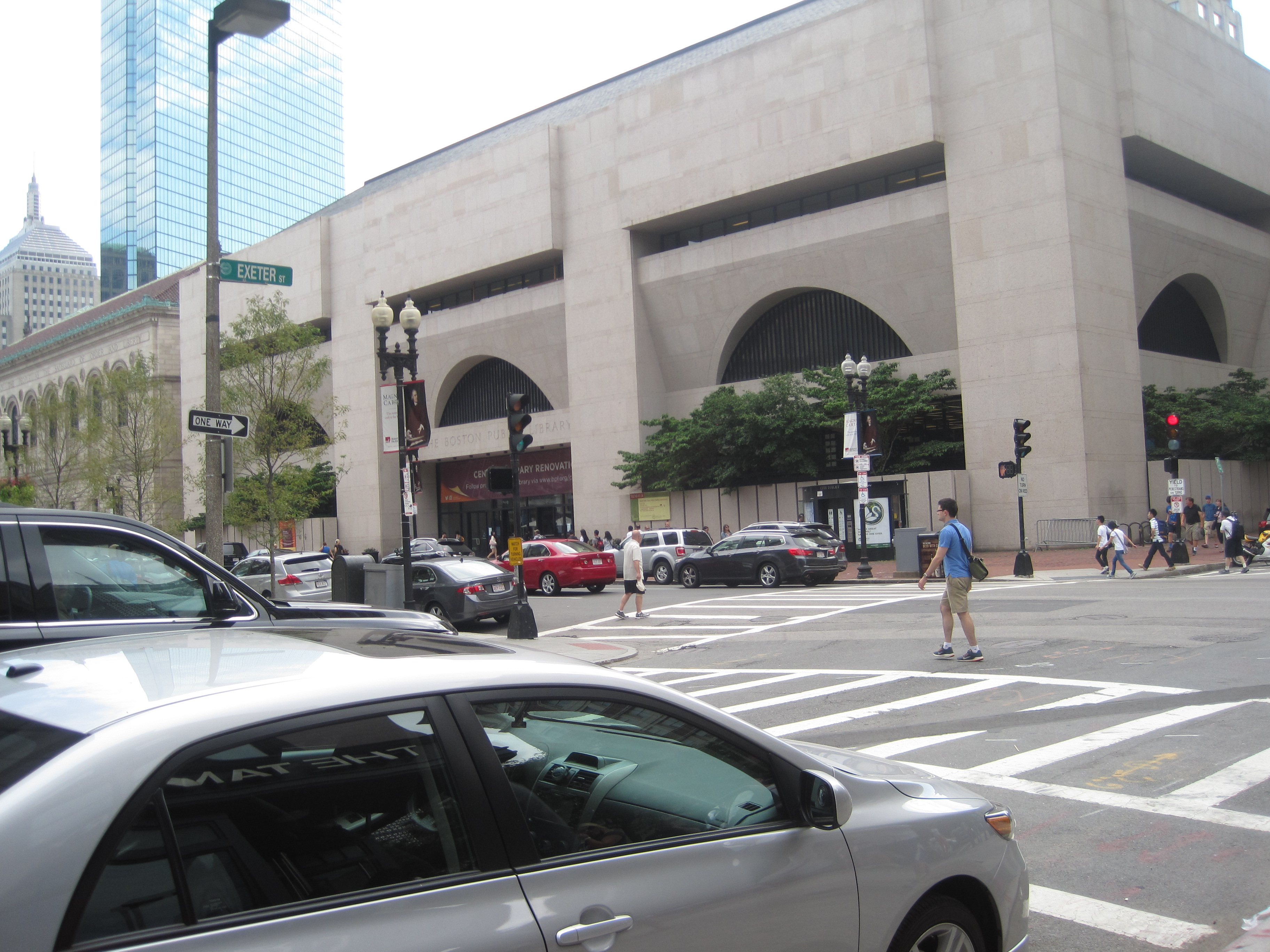
Boston Public Library

Libraries are the center of literacy. It is one of the first places a person looks for when they enter a town, a university or a school.  You know that when you see a library, you have truly reached civilization as we know it.  It is a place of refuge, a shelter and a friend to the homeless. It is a place that will take you in when no other place is willing.

This is true whether it is a public, university or school library.  Libraries are as American as Coca Cola and apple pie.  They can offer inspiration and offer a lifeline to the dejected or those down on their luck.

They can offer solace, and opens doors to the curious.  Libraries allow the reading public to go in two or three notches deeper.  For example, when I was reading some the classics for the first time, I discovered a third Bronte sister, Anne.  We knew of Charlotte and Emily.  But Anne, also wrote and I clearly remember the description of her character of Mr. Huntington in The Tenant of Wildfell Hall.

Agape.

When I was at a transition period in my life, the space and the books in the library gave me so much.  And, when, I was ready to relocate, I was able to give back as I donated quite a few rather new books to the library.

When, it comes to university libraries, there are many stories to tell.  They give students a place to wait when there is a three-hour lull time between classes. One friend shared that her university library had a couch that she used to take naps on during the semester.  I cannot say that I ever slept in a university library, but I can say that finding a quiet cubicle was nice when I wanted to tuck myself away from the frenzy and mad pace of campus life.

Actually, I started my first book in a college library as I waited for mother to finish teaching her classes.  I do not think that I would have had the discipline to start it at home nor the sturdy table to draw out my thoughts.  So waiting to drive her home was spent using the library in a wonderful way.  And university and college often stay open very late to accommodate night students. Again, the expectation is that it will be there- open and ready to serve those in need.

We simply expect it to be there.

And, lastly there are our school libraries. Again, once you enter a good school, you will look for the main office, maybe the lunchroom or gym and of course, the library.

In French, la bibliotheque!

LOC

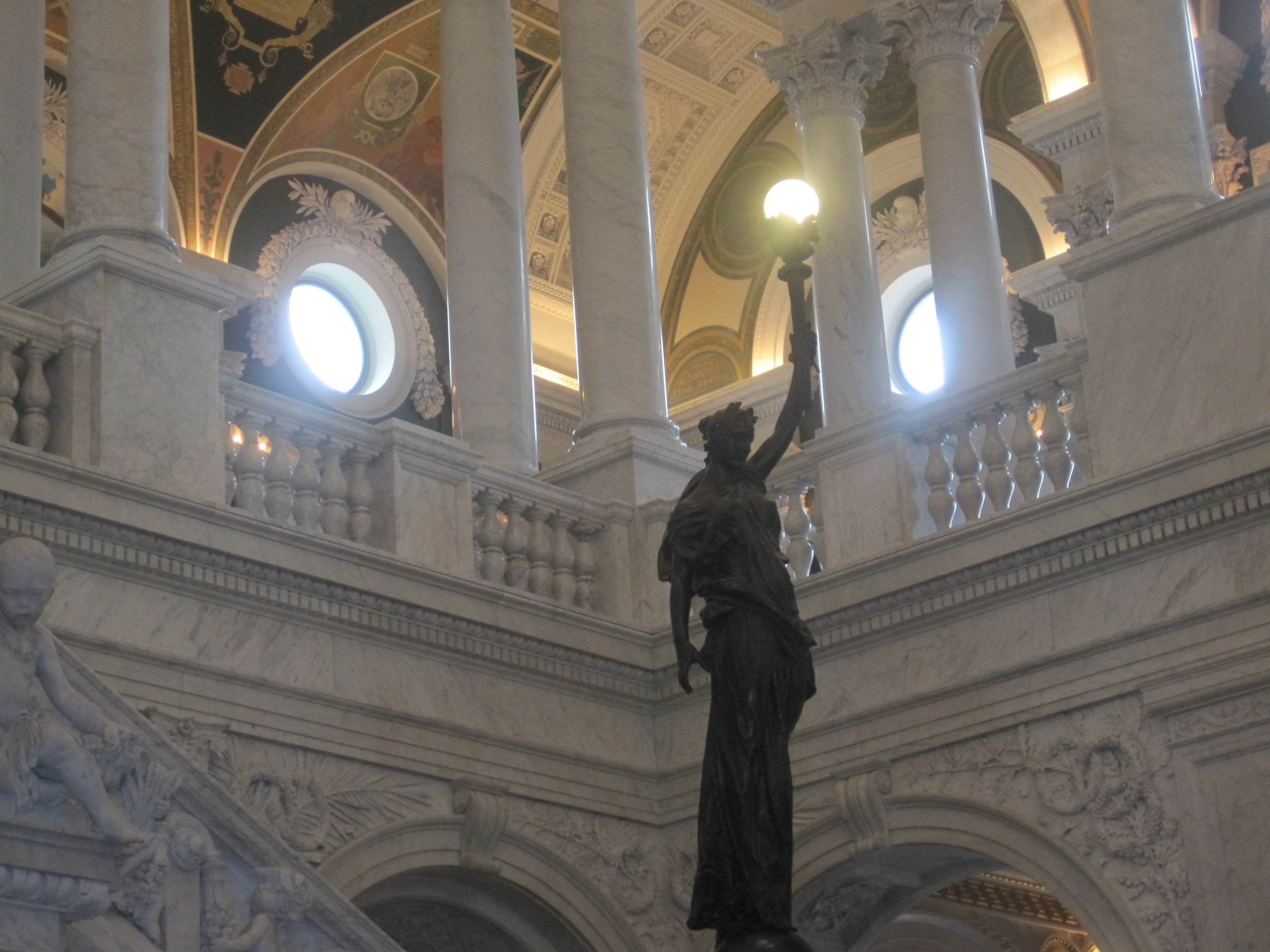
Library of Congress – Interior

I recently compared the librarian to a bartender in a conversation.  A fellow librarian agreed by giving a nod of the head.  I made the analogy because, people like to venture into our sacred spaces and tell us all of their life dilemmas.

We are skilled listeners, and we will say, “Uh huh,” as we continually scan books; catalog or put books back on the shelf.  It is where students and staff come in and take a seat and start talking.  I have heard many private tales and I am able to keep working as the speaker “spills the beans.”

Even my most disagreeable students may appear with a sweet, soft voice asking for the use of some tape or a table to spread out and complete a project.  Or, they may need to print something on the color printer so they are extra kind and soft-spoken.  In the back of your mind, I am thinking, is this the same kid?  But it reminds us that they know how to act when they really want something.

And, they also know that librarians are wonderful people and that we will not deny them the use of these materials.  So, in closing, when people enter a public, university or school library, they fully expect there to be a knowledgeable, attentive, keeper of the books who is organized and methodical and approachable.  Libraries are truly sacred spaces!

Library of Congress 2012

Library of Congress-DC

Lynn                                                                                           September 3, 2014

Make Yourself Useful!

My father used to always say, “Make yourself useful.”  I thought about this statement on this Labor Day when many will be heading back to work and the children will be returning to school.

Summer is officially over as we start storing up our fruits of labor.  We will see the harvest and stored bounty as we prepare for the upcoming winter months. I am reminded of a children’s story that a school teacher shared with me.  She said that the animal character was asking the others in his community for food during the winter months.  They asked him what he had been doing in the summer and fall.  He replied, “Dancing!”  They told him that he needed to dance through the winter.  Hard lesson!

As one of my favorite former bosses used to say that there was,”No time for such foolishness.”  That is how he perceived any activity that was either non-productive or counter-productive.  I believe that we all have a role to play as we contribute to the whole functioning of our society.  Yet, sometimes, finding that role can be illusive.  But, some work is better than no work at all.  When the full-time opportunities for work were not available to me, I often worked as a temporary work. Surprisingly, the skills that I have amassed are amazing.  There is always some work that needs to be done.

Years ago, in the black community, there was a great debate between Booker T. Washington and W.E.B. DuBois on the role of workers or laborers.  After reflecting on those talks, both men had the welfare of the workers in mind.  Whether, one is a laborer or a leader, both work roles are still very important.   Everybody cannot be a leader and everyone cannot be a follower.  But, one thing is for certain.  It takes a good leader and good team of followers to act as a unit and meet the supply and demand.  That is a simple truth.

Washington believed in training the youth with the use of their hands.  Dubois wanted to work with the potential leaders which he called the “talented tenth” and help them develop their minds.  Both men had good theories because we know that every one cannot be, as one woman put it, “The chairman of the board.”

A few years back when my mother and I taught at a community college, students were all being told that they needed a four-year degree.  We saw so many fail and being set up to fail.  Many simply were not equipped with some of the basic skills of reading and writing to be successful in completing the curriculum.

Back in my high school days, I remember walking pass the shop classes as they were then called.  It was inspiring to see the youth engaged in drafting, metal shops, printing and mechanic shops to name a few. I saw this again some years later when I worked at a technical high school and I had the same feeling of exhilaration.  I felt that they were being realistically prepared to go forward in a chosen vocation or field.  They would leave with a sense of direction and it would be up to them to decide how far they wanted to go in that particular field.

Vocations and technical skills need to be put back into our schools on a wide scale today.  Maybe if we called them ‘specialties,’ it would add to the attraction into these fields.  There would be happier workers who could see themselves more clearly and how they fit into the whole.  Again, Wikipedia said that Labor Day celebrates the achievement of workers.  It also says, “It constitutes a yearly national tribute to the contributions workers have made to the strength, prosperity, and well-being of their country.”

Workers would then be useful, resourceful, industrious and fulfilled as they make contributions to the ‘strength, prosperity and well-being of the country.’

Laboring

Lynn                                                                              September 1, 2014

Raising our Energy Levels

The old adage goes, “If you want to travel far, you have to travel light.”  Well, the same is true for traveling in thought.  Whenever someone is getting ready to jump a hurdle or flow over an obstacle, there has to be mental preparation.

There needs to be a plan and, a willingness to sacrifice heavy foods and drink. This helps the mind go quiet and allows the one who is in a creative mode to raise the energy level. It is similar to a plane that accelerates to a certain speed before it takes flight. 

Stuart Wilde writes, “”The other thing that helps is to have a more rarefied diet.  It increases your sensitivity. So, if your diet is very light or vegetarian, you become more aware of the subtle energies of life.  As you fast, your brain waves start to slow down, your metaphysical energy quickens and your mind goes quiet.”

I often eat light with certain fruits such as bananas, yogurt and will lean towards a regiment of nuts when deeply involved in some writing piece.  Also, when in season, I write by the lake.  Or as mentioned in previous posts, I put on music.  I am rather versatile when it comes to music so it can be light classical, love songs, or even spirituals.  It just depends on the subject of my writing. Today, I chose spirituals because they are perfect for this post as I write about states of consciousness.

Wikipedia says,” fasting is primarily the art of willing abstinence and reduction from certain or all foods, drink or both for a period of time.” We all know that heavy eating turns us into couch potatoes where all we do is eat, watch television and sleep.  This causes a considerable amount of sloth. People usually fast or eat less when trying to attain some goal. It acts as a form of practice or ritual to get in touch with spirit and get answers to some life issues.

Those who achieve a lot or are considered high achievers are often slim in stature and often considered highly intellectual in nature.  Unfortunately some artists can become so engaged in a project that they forget to eat.  This is not encouraged, but light eating does help raise the states of consciousness before one can as we, “get into the zone.”

There may be some dieting restraints and specific food choices are avoided so the body will not be bombarded with a sense of heaviness. Appetites must be mastered when a deadline is in view.

In the Bahai‘ Faith, they see limited intake or fasting as a believer’s time to “strive to make the necessary adjustment in his life and to refresh and reinvigorate the spiritual forces latent in his soul.”

Writers and artists of various forms of media must be in tune with their souls.  The mind needs to go quiet and one must be in contact with one’s soul.  Then those creative juices can flow and those hidden truths that are often deeply buried can surface. 

Sometimes, we do not really know how we feel about a matter until we start writing, painting or revealing our views on a matter through some form or medium.  We surprise ourselves and our audiences as the mysteries unravel.  Those who live with a creative person know to just let them be during the process and maybe just slide a light snack through the door. And then simply wait until he or she emerges from the writing room or studio, hopefully with a smile.

Lynn                                                                                                                                      August 30, 2014