Silence!

silence

At the end of the school year, we studied a short story called The Sound of Annie’s Silence. It was written by a UK author named Phyllis Fair Cowell and it revealed the unlikely bond between two high school girls.  Annie was mute and the narrator became her babysitter.  She thought the job would be easy until she was disturbed by the silence while in Annie’s presence.

This caused a variety of lively discussions about silence itself.  We brought out the fact that in this high-tech age filled with sounds and beeps, few are really comfortable with silence.  Each moment must be filled with some type of noise or chatter.

We are usually talking, texting, emailing, listening to YouTube or television or having some external engagement with our devices.  In contrast, total silence it simply too stark and surreal for most people and like the narrator, we immediately find something to fill the void and rush to hear some sounds.  When the young girl telling the story could not deal with Annie’s silence, she grabbed their coats and headed outdoors for a walk to the park.

Yet, silence can be beautiful for those of us who are older and more seasoned.  When I demanded a totally quiet classroom, one student later remarked, “Wow!  I got so much done.”  I laughed to myself and thought, “Well, yeah.”

At one point, I felt like making a recording saying, “Stop talking!.” or “Voices are off!   or ”Silencio!”  [for the bilingual classes]  I believe that several students learned that silence can be a wondrous event.  Thinking is allowed.  Energy is preserved. Work is completed.

More should simply hush and listen.  Perhaps, the answer to a long-standing question is sitting right there, waiting for us to become silent enough to hear it.

“Silence is true wisdom’s best reply.”  Euripides

Lynn M.                                                                                  June 8, 2016

Restoration

BPL Courtyard

Sometimes, we have to go back to old familiar territory to breathe and restore our Spirits. After all, every past year of our lives still belong to us and we have the right to borrow from already charted waters.

I recently taught a story called Eleven by Sandra Cisneros and she graciously reminded us that we are a composite of all of the ages that we have ever been. She says that we keep aging, but we never forget the experiences of each year that we have lived.

I wrote:

Every year, every tear,
Of the past.
Brought us to where
We are now.
Every lift, every fall,
Every stumble, every bumble.
Led us to this very day.

When there is a need for a feeling of wholeness, we can always revisit our former places to retrieve a sense of balance. We need to feel good so that we can calmly walk through the open doors awaiting us.

We may need to take a step back before we can move forward. Going to spaces and places that offered us recompense in the past strengthen and steady us as we evolve into whoever we are becoming.

Then, we can lean back and do an Ali shuffle and rope-a-dope our fears as we welcome the new and sure!

Lynn M.                                                                 June 5, 2016

Budding Writers!

Have you ever been given the commission to lead some young-uns and put them on a higher path?  Well, I recently had that task when I attempted to teach the beauty of the writing process to a group of middle-schoolers.

And now, as graduation tassels are being flipped and summer vacations are in view, I see smiles for miles.  They are saying, “We did it!”  And I graciously remind them that they are successful because they are good students and they followed my guidance.  Simple enough!

They followed my voice. My intonations. My examples. My formats and formulas.  And, yes. our frustrations did surface on some days.

They had to write in longhand.  They had cramping fingers and often did finger exercises.  And, yes, to their shock and dismay, they had to use ink pens.

Here are some of the orders that I barked out on a regular basis.

“Yes, use a pen with blue or black ink. No green, red, purple or any other color!”

“No!  No pencils!”

“Pencils are for math.”

“No, do not scratch out words.”

“I have two bottles of white-out on my desk.”

Some days, the entire room smelled like white-out as they carefully painted across their errors.  I laughed to myself, but they were learning to be meticulous and conscientious.

And, could they write all the way to the right end of the notebook paper?

“Hecky no!”

“There is a red line.  Respect that margin!” my voice raised.

Will they ever forget the experience?  Probably not.  Because now they are begging to read their papers to the class.

Others are showing those who were absent how to write a perfect five-paragraph paper filled with discussions and supported by evidence from the text with page numbers.

This should get them through high school and college because they listened. And now, voila!  We have a host of nouveaux auteurs or new writers!  And who knows?  There may be a few budding authors in our midst!  Selah.

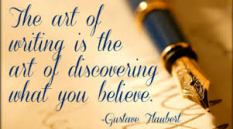
Flaubert


Lynn M.                                                                                                  May 29, 2016

Open Windows!

images

There are so many lessons from our childhoods that guide us and encourage us to do the right thing.  Prompters like The Golden Rule or turn the other cheek or Mother Teresa’s poem Anyway along with a host of other pointers, nudge us towards making good choices in life.

One of my favorite poems is If by Rudyard Kipling which reminds me to keep my head when everyone else is losing theirs and blaming it on me.  Many lines have been written to help us to keep on forging ahead and remember that”when the going gets tough, the tough get going.” Winston Churchill, who saw two World Wars, penned, “If you are going through hell, keep going.”

All of those sayings have stood the test of time and are still true today. We must strive to maintain a level of peace and poise during the challenging times.  When we get to the other side, there will be a light-filled zone and the occasion for a victory dance.

Good choices, silver linings, happy outcomes along with a good reputation  will be intact.  All of those wondrous things will show up to embrace us with loving arms of comfort.  We simply must hold on and hold out and the fresh, open windows of opportunity will surely breeze our way.

Lynn M.                                                                                             May 22, 2016


#Am Writing!

Writng

Writers are often looking for good topics.  They have to be keen observers of life and in a moment’s notice, they may have an aha moment.  Something appears across their screens and the writing process begins.

Ideas flow and the fountain pours with speed.  The moving hands can barely stay ahead of the race.  There is a writing marathon which hopes to capture all that has been revealed.

I was looking at Author Sandra Cisneros speak on You Tube, from the Book Festival of 2012. She talked about never running out of material or things to write about because she reminded her audience that we live stories throughout the day.

That was such an interesting take on life because it holds true.  She talked about stories being born every moment that we participate in this life.  The real challenge for writers is to find the time to sit down and put the words on a page of paper.

Every encounter with another person is a potential story or vignette.  Life lessons are being learned and experienced minute by minute.  Small things such as chatting with a colleague at the local grocery story can easily turn into a story.

Every day offers several simple stories.  Watching how others spend their time as they wait for their clothes to wash or dry at a laundromat could evolve into some mini tales.

Some may read or organize business papers while others tap out messages on their electronic devices; but with the addition of that creative touch, some truth may shine through in the form of a narrative.

It is the little things that people do on a daily basis that often pique the interest of readers.  Afterall, emotions and responses are universal and many can identify as they also travel through this life.

The beauty lies in the fact that someone took the time to write it down or pen it.  Thus, hearts are touched and snippets of everyday occurrences are shared.

Writers remind us that we are indeed alive and that each moment is filled with delightful little stories. Ernest Hemingway said it best when he said, “To write about life, you must live it!”

Lynn M.                     May 15, 2016

Good Reads!

What propels writers to pick up their pens?  What have they seen, felt or heard that will not leave their spirits alone until it is scribbled out on a page?

When writers have that divine discontent or that restlessness to tell a tale, they have been known to use napkins, paper towels or any available paper.  They must unleash that flow of words to capture those thoughts and feelings.

Those motifs refuse to stay dammed up or held back.  So, they push their way forward while the scribes act as mere instruments used for expression.

Some stories must be told, shared or made visible to the human eye. They can be compared to a hefty sub sandwich bearing all of the outer wrappings before biting into the meat or main ingredient.

A plot unfolds after the characters and setting are introduced in quite in the same way that the crusted bread lays the foundation for a good sandwich.   The mayo and condiments can be equated to the suspense that builds as the story reaches a crescendo.

And then, at last, something key happens. The reader sits up and takes notice.  The pages are turned more rapidly to see what will happen next. After things have come to a rest, everyone is altered or changed in some way, including the reader.

A bite has been taken in the sandwich and the meat has been tasted.  The reader inaudibly replies,  “Ah, there is the rub.” The lesson is clear.  It is well-received. The reader sits back after digesting  the book and sighs, “Now, that was a good read.

Open-Book460_276

Lynn M.                                                                                                  May 8, 2016

Blooming April!

lilacs

April.

April.

When I think of April, I think of Walt Whitman’s poem and tribute to President Abraham Lincoln, so poignantly titled, When Lilacs Last in the Dooryard Bloom’d after the President’s April death.

It is the blooming season.  It is the  brink- that time right between the end of things and the beginning of the new, waiting to burst forth.

When I think of April, I think of that season where great souls sigh.  Many take that last breath and release all that has been.  They have fought the good fight and as they laid down their coats of arms, they said, “I gave it my all.”

They have turned it over and simply say, “Well, let’s see what others have to say about my contributions, my talents and my gifts.  I shared what was graciously given to me.”

And the list begins with those who exhaled in April:

Prince, renowned musician and artist

Doug Banks,  Chicago radio talk show host

William Shakespeare, playwright

Abraham Lincoln,  16th President of the US

Martin Luther King, Jr.,  Preacher

 Chester, my grandfather

 Oscar, my father.

And yes, there are so many more that were released during this blooming season, but those are the ones who spring to mind.

They will remain because they left their footprints in the sand. Their charted paths point the way for those of us who are still here.

Lynn M.                                                                                    April 24, 2016


Speaking Truth to Literature

Ernest Hemingway said, “You have to be hurt like hell before you can write seriously,” in a letter to F. Scott Fitzgerald. Writing in itself is a very tedious process. It requires much from the human spirit. But, if there is a divine discontent stirring deep in the soul, it must come out. Dr. Maya Angelou said, “There is no greater agony than bearing an untold story inside of you.”

Just like the truth, it refuses to remain hidden. Jean Racine writes, “There are no secrets that time does not reveal.” It is comparable to the Greek Myth where King Midas’ barber was told to keep a secret about the king’s donkey ears. The barber could not bear it any longer so he went up high into the mountains, dug a hole in the midst of some reeds and whispered the secret. He had gotten it off his chest, but then Echo picked it up and it was scattered all over the world

In much the same way, writers unburden themselves when they feel that the world is too much with them, as Wordsworth wrote. They pick up a pen or sit at a computer and let their fingers move until they have unleashed the energy in some creative form. Some people can walk right pass a ghastly situation and remain unmoved or unaffected. Others may feel it, but don’t know how to process their emotions so they cling to other outlets to mask their pain.

Writers and poets express though it may be in the form of fiction. It may have artificial names and invented towns, but there is a message at the core of the story. There has been some observation of life that cannot be ignored and the writer is compelled to develop a literary work.

And that is how thoughtful stories are spun and library shelves are filled. Final products such as Faulkner’s A Rose for Emily or Toni Morrison’s The Bluest Eye or Hemingway’s A Sun Also Rises were born along with a long host of other literary works.

These observers saw the events unfolding around them and they had to do something to survive them, so they wrote. Faulkner dealt with small town life; Morrison, the daily routines of an oppressed domestic and Hemingway, wartime Europe from the eyes of an American.

They each spoke their truth and decided to wrap it up in candy wrappers, so it wouldn’t be too bitter. Readers digested it and the obvious reply was a resounding yes, because they are all considered to be masters of literature!


Lynn M.                                                                April 18, 2016


100 Quarters!

quarters

Have you ever made a long distance call from a pay phone? Do you remember the receiving party patiently waiting while the operator told you how much money was due?  Those were the days.

It seemed like you were depositing 100 quarters and the other person waited and waited and waited.  The change registered with a  cha ching, slowly, steadily but surely.  By the time you had put all of those coins in the slot, chances are, you forgot what you had called to say.

You were so focused on putting in the money and hoping that you didn’t lose the connection.  This was known to happen back then and you may or may not get your money back.  Then, you would have to start the entire process all over again.

When the two parties finally connected, you had to tell “thy story quickly” as Macbeth said.  I thought about this the other day when I saw an actual pay phone.  I should have taken a picture of it!  They are real relics now and they rarely exist, except in airports of course.

My, my, how things have changed regarding long distance calls.  If you have ever lived away from home, so to speak, and before the advent of the cell phone, you may remember the stress equated with long distance calls. If you were calling from home, there were the huge phone bills.  If you were at a pay phone, plenty of change was needed.

Nowadays, calling long distance can be done with a flair.  No big deal.  You just tap out the number from your cell phone and if someone picks up, it’s a go.  Easy; no wait.  Carole King’s song, So Far Away, doesn’t play in the background of your mind because there is no fanfare and the voices don’t sound like you are miles away.

Tech progress.  Yes!  The days of the bag of 100 quarters are over!  Whew!


Lynn M.                                                                               April 14, 2016