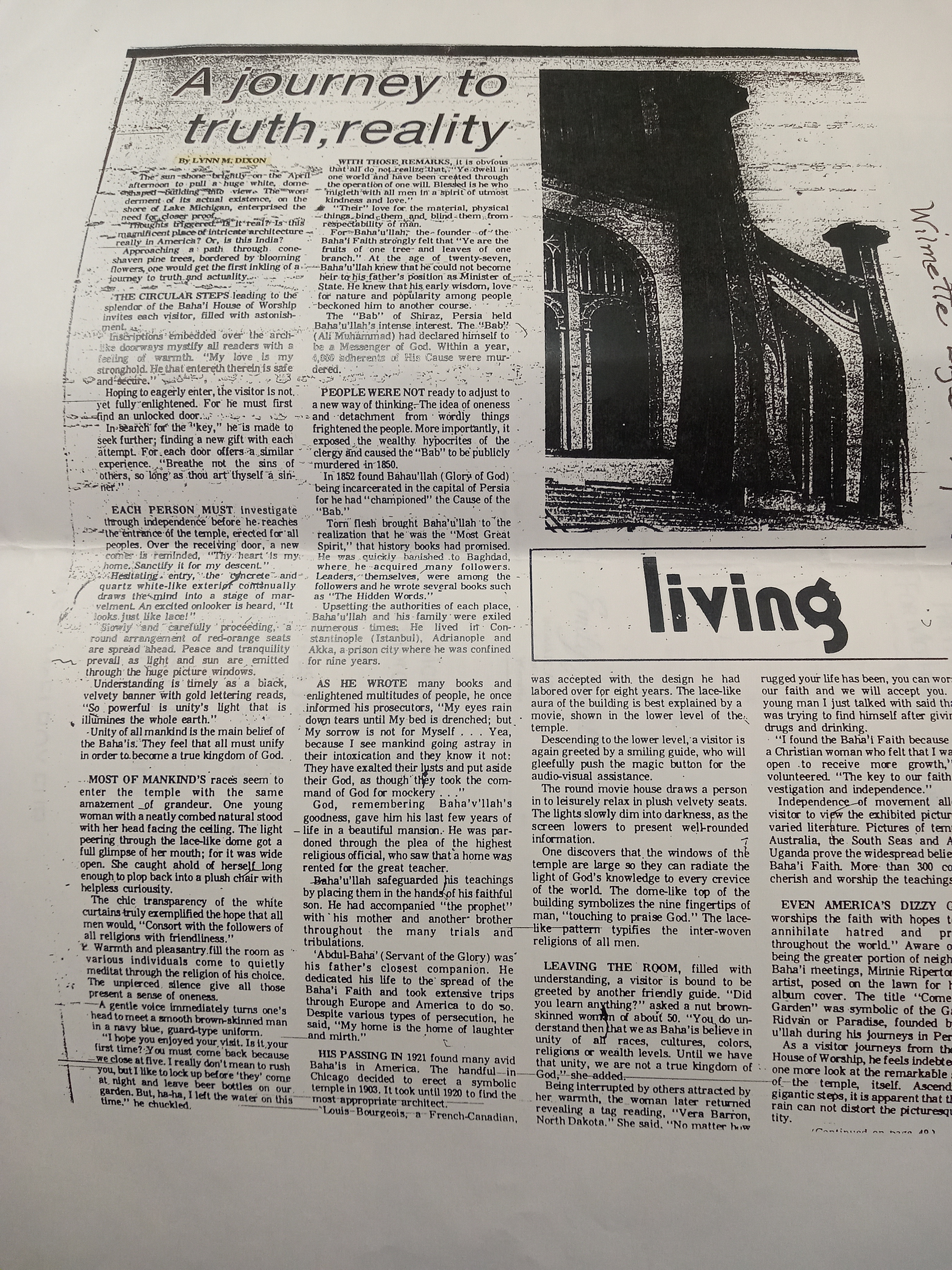
{This article was originally published in the Wilmette Life in April of 1977}
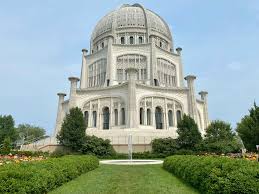
The sun shone brightly on the April afternoon to pull a huge white dome-shaped building into view. The wonderment of its actual existence on the shore of Lake Michigan, enterprised the need for closer proof. Thoughts triggered, “Is it real? Is this magnificent place of intricate architecture really in America? Or is it India?”
Approaching a path through cone-shaven pine trees, hardened enhanced by blooming flowers, one would get the first inkling of a journey to truth and reality. The circular steps leading to the splener of the Baha’i House of Worship invites each visitor, filled with astonishment.
Inscriptions imbedded over the arch-like doorways mystify all readers with a feeling of warmth, “My love is my stronghold. He that entereth therein is safe and secure.” Hoping to enter, the visitor is not yet fully enlightened, for he must first find an unlocked door.
In search for the ‘key,’ he is made to seek further; finding a new gift with each attempt, for each door offers a similar experience. ”Breathe not the sins of others, so long as thou art thyself a sinner.” Each person must investigate through independence before he reaches the entrance of the temple, erected for all peoples. Over the receiving door, a newcomer is reminded, “Thy heart is my home. Sanctify it for my descent.”
Hesitating entry, the concrete and quartz white-like exterior continually draws the mind into a stage of marvelment. An excited onlooker is heard, “It looks like lace!” Slowing and carefully proceeding, a round arrangement of red-orange seats are spread ahead. Peace and tranquility prevail as light and sun are emitted through the huge picture windows.
Understanding is timely as a black, velvety banner with gold lettering reads, “So powerful is unity’s light that it illuminates the whole earth.” Unity of all mankind is the main belief of the Baha’i. They feel that all must unify in order to become a true kingdom of God.
Most of mankind’s races seem to enter the temple with the same amazement of grandeur. One young woman with a neatly combed natural stood with her head facing the ceiling. The light peering through the lace-like dome got a full glimpse of her mouth, for it was wide open. She caught ahold of herself long enough to plop back into a plush chair with helpless curiosity.
The chic transparency of the white curtains truly exemplified the hope that all men would, “Consort with the followers of all religions with friendliness.” Warmth and pleasantry fill the room as various individuals come to quietly meditate through the religion of choice. The uppierced silence give all those present a sense of oneness.
A gentle voice immediately turns one’s head to meet a smooth brown-skinned man in a navy blue, guard-like uniform. “I hope you enjoyed your visit. Is it your first time? You must come back because we close at five. I really don’t mean to rush you, but I like to lock up before ‘they’ come at night and leave beer bottles on our garden. “But,” hehe, “I left the water on this time,” he chuckled.
With these remarks, it is obvious that all do not realize that, “Ye dwell in one world and have been created through the operation of one will. Blessed is he who migleth with all men in a spirit of utmost kindness and love.” Their love for the material, physical things, bind them and blind them from respectibility of man.
For Baha’-u-llah, the founder of the Baha’i faith strongly felt that, “Ye are the fruits of one tree and leaves of one branch.” At the age of Twenty-seven, Baha’-u-llah knew that he could not become heir to his father’s position as Minister of State. He knew that his early wisdom, love for nature and popularity among people beckoned him to another course.
The ‘Bab’ of Shiraz, Persia held Baha’-u-llah’s intense interest. The “Bab; ( Ali Muhammad) had declared himself to be a Messengeer of God. and within a year, 4000 adherents of His Cause were murdered. People were not ready to adjust to a new way of thinking. The idea of oneness and detachment from worldly things frightened the people. More importantly, it exposed the wealthy hypocrites of the clergy and caused the ‘Bab; to be publicly murdered in 1850.
In 1852, Baha’-u-llah ( meaning Glory of God) was incarcerated in the capital of Persia for he had ‘championed’ the Cause of “Bab.” Torn flesh brought Baha’-u-llah to the realization that he was the “Most Great Spirit.” that the history books had promised. He was quickly banished to Baghdad, where he acquired many followers. Leaders, themselves, were among the followers and he wrote several books such as The Hidden Words.
Upsetting the authorities of each place Baha’-u-llah and his family was exiled numerous times. He lived in Constanttinople (Istanbul), Adrianople and Akka, a prison city where he was confined for nine years.
(To Be Continued)
Lynn M.
June 6, 2026


Interesting story. I look forward to more.
LikeLiked by 1 person
Thanks, Mary. I posted Part 2 yesterday. I wrote this for a Feature Story writing class years ago. I re-posted this after my sister recently visited the Baha’i House of Worship. That made me think about this piece. Thanks much, Lynn
LikeLiked by 1 person
Ah Lynn, this is so interesting. I shall look forward to Part 2! Did you write the article?
LikeLike
Yes, Val. When I was 26, so I have grown as a writer. It was published in a local newspaper and a surprise check found me because I had left the area for grad school in Mississippi. Thanks so much! Lynn
LikeLike