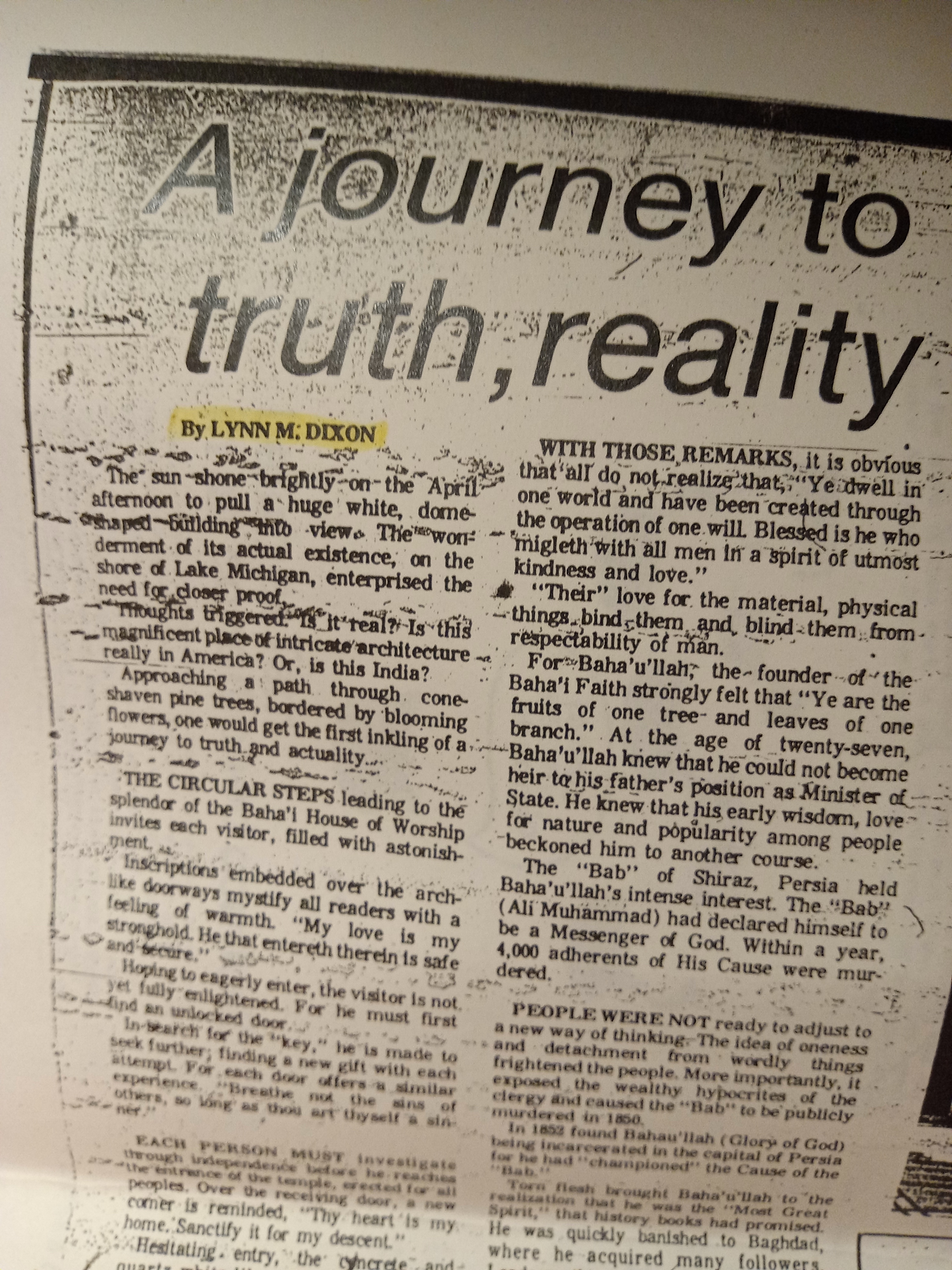
As he (Baha-u-llah) wrote many books and enlightened multitudes of people, he once informed his prosecutors, “My eyes rain down tears until My bed is drenched, but ‘My sorrow is not for Myself,”… Yea because I see mankind going astray in their intoxication and they know it not. They have exalted their lusts and put aside their God, as though they took the command of God for mockery.”
God, remembering Baha-u-llah’s goodness, gave him his last few years of life in a beautiful mansion. He was pardoned through the plea of the highest religious official, who saw that a home was rented for the great teacher.
Baha-u-llah safeguarded his teachings by placing them in the hands of his faithful son. He had accompanied ‘the prophet’ with his mother and another brother throughout the many trials and tribulations.
‘Abdul-Baha’ (Servant of the Glory) was his father’s closest companion. He dedicated his life to the spread of the Bahai faith and took extensive trips through Europe and America to do so. Despite various types of persecution, he said, ‘My house is the home of laughter and mirth.”
His passing in 1921 found many avid Baha’is in America. The handful in Chicago decided to erect a symbolic temple in 1903. It took until 1920 to find the most appropriate architect. Louis Bourgeois, a French Canadian, was accepted with the design he had labored over for eight years. The lace-like aura of the building is best explained by a movie shown in the lower level of the temple.
Descending to the lower level, a visitor again is greeted by a smiling guide, who will gleefully push the magic button for the audio-visual assistance. The round movie house draws a person in to leisurely relax in the plush velvety seats. The lights slowly dim into darkness, as the screen lowers to present well-rounded information.
One discovers that the windows of the temple are large so that they can radiate the light of God’s knowledge to every crevice of the world. The dome-like top of the building symbolizes the nine fingertips of man, ‘touching to praise God.’ The lace-like pattern typifies the inter-woven religions of all men.
Leaving the room filled with understanding, a visitor is bound to be greeted by another friendly guide. “Did you learn something?” asked a nut brown-skinned woman about 50. “You do understand then that we as Bahais believe in unity of all races, cultures, colors, religions or wealth levels. Until we have that unity, we are not a true kingdom of God,” she added.
Being interrupted by others attracted by her warmth, the woman later returned revealing a tag reading, “Vera B. of North Dakota.” She said, “No matter how rugged your life has been, you can worship our faith and we will accept you. I just talked to a young man who said that he was trying to find himself after giving up drinking and drugs. I found the Bahai Faith because I was a Christian woman who felt that I was open to receive more growth,” she volunteered. “The key to our faith is investigation and independence.”
Independence of movement allowed this visitor to view the exhibited pictures and varied literature. Pictures of temples in Australia, the South Seas, and in Africa’s Uganda prove the widespread belief of the Bahai faith. More than 300 countries cherish and worship the teachings.
Even America’s Dizzy Gillispie worships the faith with hopes to help annihilate hatred and prejudice throughout the world. Minnie Riperton, a musical artist, posed on the lawn for her album cover. The title “Come to My Garden,” was symbolic of the Garden Ridvan or Paradise founded by Baha-u-llah during his journeys to Persia.
As a visitor journeys from the Bahai House of Worship, he feels indebted to take one more look at the remarkable splendor of the temple. Ascending the gigantic steps, it is apparent that the misty rain can not distort the picturesque serenity.
Another brief moment of silence might again introduce another ‘blessed guide.’ Sitting with a book resting in one hand and a shawl held by the other, hiding a name tag, a young, smiling feminine face added, “I hope you don’t get wet.” Departing from the emerging dome of positivity, another guide in the information house, slipped onto the porch to sneak in a farewell wave, though talking on the phone.
One can sense the attainable depth of Baha-u-llah’s faith as he briefly travels through the “Seven Valleys.’ The valleys of Search, Love, Knowledge, Unity, Contentment, Wonderment, and True Poverty and/or Absolute Nothingness are all lightly tapped after a couple of illustrious visits. If ever one of God’s ‘branches’ leaves the Baha’i House of Worship unfulfilled, he should remember the words of the gentle North Dakotan woman. She said, “You investigate that!”
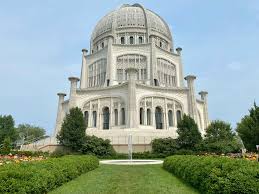
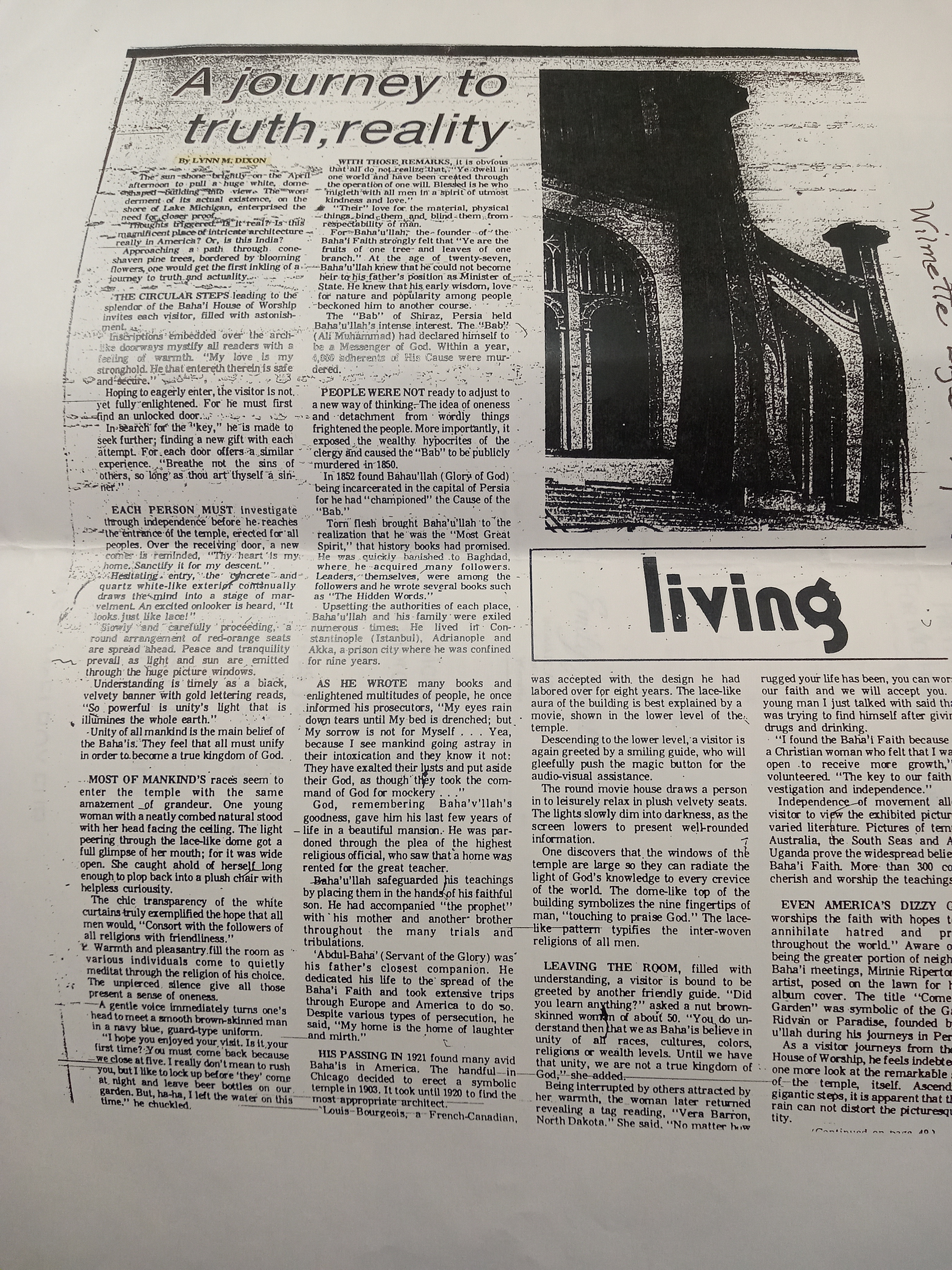
[Published in The Wilmette Life Newspaper in April, 1977 by Lynn M. Dixon. The public liked it and a $40 check found its way to me in Jackson, Mississippi, where I had moved to attend graduate school.]
Lynn M.
June 13, 2026


You must be logged in to post a comment.